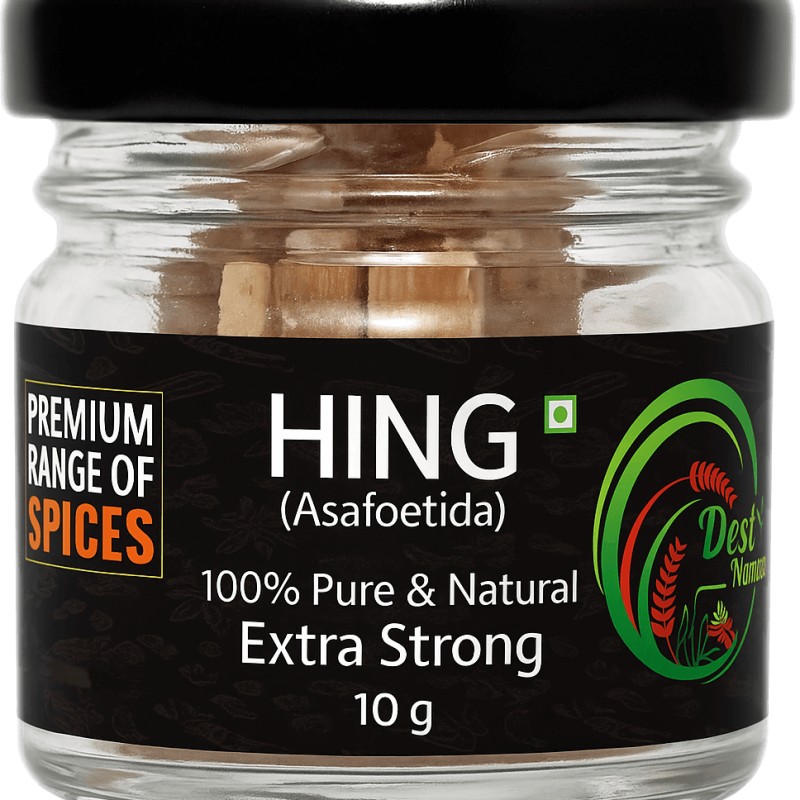
Hing is the one spice where using too much is a more common mistake than using too little. A pinch too many and your dal smells like a garlic factory that caught fire. A pinch too few and nobody notices it was there. Most of the confusion comes from the fact that "hing" in India covers two quite different products.
What hing actually is
Hing, or asafoetida, is the dried resin of the root of Ferula plants. The sap is collected from the cut root, dries into a sticky, brownish lump, and is traded in that form. Most of it is grown in Afghanistan, Iran and Central Asia and has been imported into India for centuries, which is a little funny for a spice so completely Indian in its use. Small trial plantings in the Himalayas have started only recently.
Raw resin is ferociously strong and sticky. It is hard to measure and it does not keep a pinch-sized shape, so most of it gets processed before it reaches your kitchen.
Compounded hing
This is the yellow or off-white powder most families know. The resin is ground and blended with an edible base, usually wheat flour, rice flour or another starch, often with gum arabic to bind it. FSSAI recognises this as "compounded asafoetida" and the label should say so.
- Strength: mild to moderate, because much of what you are spooning is the base.
- Easy to use: it pours, it measures, it does not stick to the spoon.
- Worth knowing: if the base is wheat flour, compounded hing is not gluten-free. People avoiding gluten should read the ingredient list, not just the front of the pack.
Pure, or nearly pure, hing
Sold as small lumps, granules or a darker powder with very little filler. It is many times stronger than the compounded kind. Kitchens that use it often dissolve a crumb in a spoon of warm water and add the liquid, so it spreads evenly instead of landing in one bitter spot.
Neither is "better" in every dish. Compounded hing is forgiving and suits everyday cooking. The stronger kind is lovely in pickles, kadhi and South Indian dishes where you want that deep, oniony note without adding much.
How to tell which one you have
- Read the ingredients. Flour, starch or gum arabic listed after asafoetida means compounded. This is the only reliable check at home.
- Look at the colour. Bright yellow often means turmeric or a coloured base was used. Darker, browner powder usually has more resin. Not a rule, but a hint.
- Smell the closed pack. Strong hing announces itself through a zip-lock. Weak hing waits for you to open it.
How much to use
For a pot of dal for four:
- Compounded hing: about 1/8 teaspoon. A generous pinch, not a spoonful.
- Strong hing: a crumb the size of a rice grain, or a very small pinch of the powder. Start there and go up next time.
And it always goes into hot fat, never straight into water. A few seconds in ghee or oil is what turns the raw, sulphurous smell into the rounded flavour you want. We have written a whole piece on tadkas from across India; in almost every one, hing goes in just before or just after the seeds, and comes out of the heat within seconds.
Storing it
Hing loses strength slowly once opened, and it will happily perfume everything near it. Keep it in an airtight tin or jar, away from the stove's heat, and away from your tea leaves (learned the hard way by more than one household). A pack used within a few months will be noticeably stronger than one that has sat open since last Diwali.
If you want to try ours, our hing comes in a 10 g airtight pack. Like any hing, start with less than you think you need.