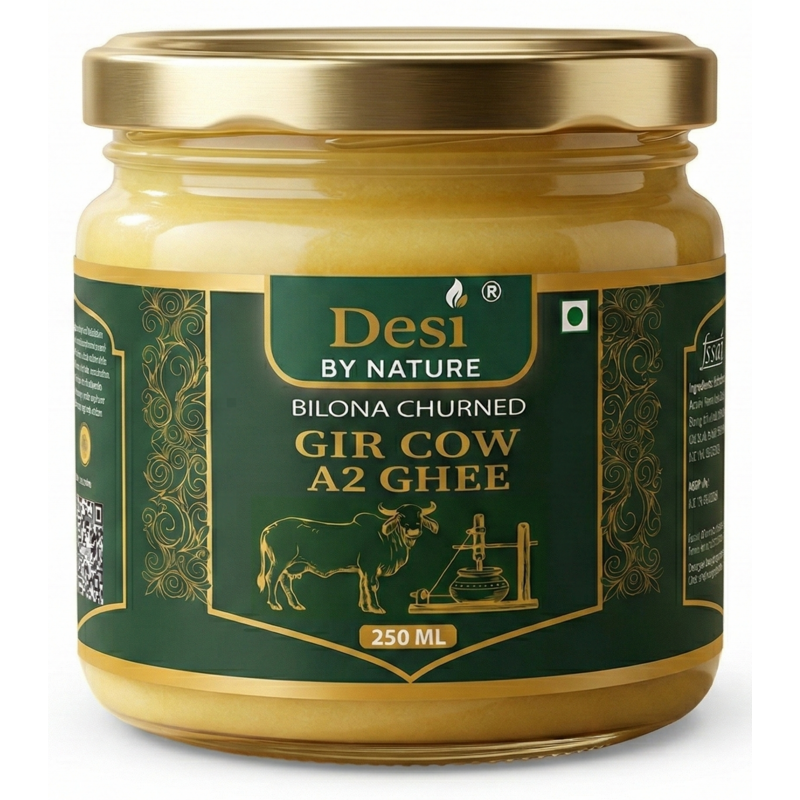
Ghee is one of the most adulterated foods in India. The usual additions are vanaspati (hydrogenated vegetable oil), refined vegetable oils, and starch used as a cheap bulking agent. None of them are visible in a sealed jar.
Here are five tests you can run in a home kitchen, roughly in order of how useful they are, along with a plain account of what each one proves and what it does not.
1. The palm test
Put a small amount on your palm. Pure ghee melts at body temperature and turns liquid within a few seconds. Ghee cut with vanaspati or palm-based fat has a higher melting point and sits there.
What it proves: very little on its own. It is a quick screen, not evidence. Plenty of adulterated samples will still melt readily.
2. The heat test
Heat a teaspoon in a clean pan. Pure ghee melts almost immediately, turns a deep golden brown, and releases a strong nutty aroma. Adulterated ghee tends to melt more slowly and stays a pale yellow with a flat smell.
What it proves: useful and cheap, but it depends on you knowing what real ghee smells like. It is a comparison test more than an absolute one.
3. The refrigeration test
Melt a few spoons, pour into a clear glass jar, and put it in the fridge for a few hours. Pure ghee sets as one uniform mass. Ghee blended with another fat tends to set in visible layers, because the fats have different solidification points.
What it proves: this is one of the better home tests. Distinct layering is a genuine warning sign. A uniform set is reassuring but not conclusive, since a well-blended adulterant with a similar melting profile can set evenly.
4. The iodine test for starch
Melt a teaspoon of ghee, let it cool slightly, and add two or three drops of iodine tincture from a pharmacy. If the mixture turns blue or blue-black, starch is present. Boiled potato, sweet potato and other starches are used as cheap fillers to add weight and body.
What it proves: this one is genuinely reliable. Iodine turning blue-black in the presence of starch is a well-established chemical reaction. If you see it, there is starch in your ghee, and starch has no business being there.
5. The Baudouin test for vanaspati
This is the official test, and it is the one the FSSAI uses. It is described in detail in a separate article, because there is a genuinely interesting reason it works and a serious safety caution attached to it.
The short version: it uses concentrated hydrochloric acid, which is dangerous to handle, and it detects sesame oil rather than vanaspati directly. It works because Indian law requires vanaspati to contain sesame oil precisely so that this test catches it.
What it proves: a great deal, when done correctly by a laboratory. We would not recommend running it on a kitchen counter.
Where home testing stops
Every test above detects a crude adulterant. None of them detect the things that actually distinguish good ghee from mediocre ghee: whether it came from A2 or A1 milk, whether it was churned from curd or from cream, what the free fatty acid content is, or whether the moisture level is within the legal limit.
Those require laboratory equipment. That is the honest limit of what you can establish in a kitchen, and any brand telling you otherwise is overselling.
What to check before you even open the jar
- The FSSAI licence number on the label. It should be a 14-digit number, and you can look it up on the FSSAI's public register. A brand that prints only a logo and not a number is asking you to take the certification on faith. Ours is 11525079000402.
- The ingredient list. Ghee has one ingredient. If there are two, put it back.
- A batch number and a packing date. Their absence tells you something about the operation behind the jar.
- The packaging material. Glass is inert. Warm fat sitting in plastic for months is a different proposition.
Our A2 Gir cow ghee is churned from curd using the bilona method and every batch is tested before it is sold. If you want the results for the specific batch you received, send us the batch code on WhatsApp and we will share what we have. See the ghee.