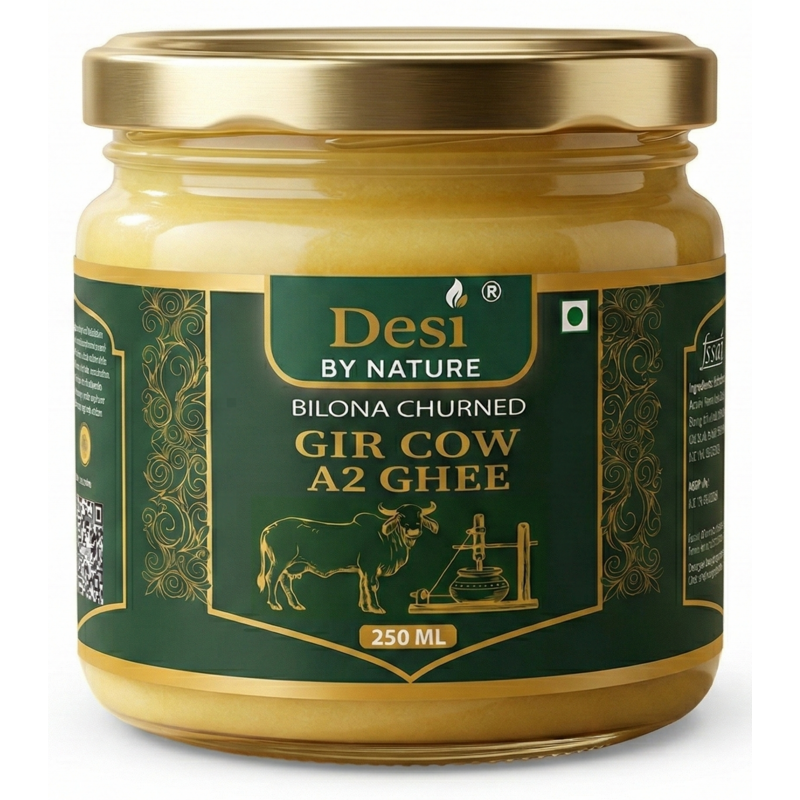
Almost every premium ghee sold in India now says "bilona" somewhere on the label. The word describes a process, and the process is genuinely different from how most ghee is made. Here is what actually separates the two.
The bilona method: curd first
The traditional sequence is:
- Whole milk is boiled and cooled.
- It is cultured into curd (dahi) and left to ferment, usually overnight.
- The entire curd is churned, traditionally with a wooden churner, until butter (makhan) separates.
- The butter is simmered slowly until the water evaporates and the milk solids brown, leaving ghee.
The defining feature is that the whole milk becomes curd before anything is separated. The fermentation step comes first.
The modern method: cream first
Industrial production runs differently:
- Milk goes through a centrifugal separator, which extracts the cream.
- The cream is churned into butter.
- The butter is clarified into ghee.
There is no curd and no fermentation. It is faster, needs less milk per kilogram of output, and is far easier to run at scale. It also produces perfectly legitimate ghee. It is simply a different product.
What the fermentation step changes
Flavour. This is the most noticeable difference. Culturing produces compounds, particularly diacetyl and lactic acid, that survive into the finished ghee. Bilona ghee tends to taste more complex and smell considerably stronger. People raised on commodity ghee sometimes find it too intense at first.
Texture. Curd-churned ghee more often sets grainy rather than smooth, though graininess has more to do with cooling rate than with the method alone.
Yield, and therefore price. This is the honest economic core of it. Churning whole curd extracts fat less efficiently than a centrifuge does. It commonly takes somewhere in the region of 25 to 30 litres of milk to produce a litre of bilona ghee, against considerably less for the cream-separated route. The exact figure varies with the fat content of the milk.
That ratio is the reason bilona ghee costs what it costs. If a ghee is described as bilona and priced near commodity ghee, the arithmetic deserves a question.
How to tell which you have bought
Honestly, from the jar alone, you often cannot. There is no home test that distinguishes curd-churned from cream-separated ghee, and the word "bilona" is not a legally protected term in the way that, say, a geographical indication is.
What you can do:
- Look at the price against the yield. The milk-to-ghee ratio sets a floor on what bilona ghee can cost to make.
- Smell it. Cultured ghee is markedly more aromatic. Once you have had both, the difference is not subtle.
- Ask the brand to describe the process in order. Whether the milk is cultured to curd before churning, or the cream is separated first, is a simple question with a specific answer. Vagueness is informative.
- Check the FSSAI licence number on the label against the public register.
Is bilona better?
For flavour and aroma, we think clearly yes, and that is a matter of taste rather than a health claim. Traditional practice also holds that the fermentation step aids digestibility; the direct evidence for that in the finished fat is thin, and we are not going to dress it up as settled.
What we can say plainly: it uses more milk, it takes longer, it tastes stronger, and it costs more to make. Whether that is worth it to you is a reasonable thing to decide after trying it, not before.
Our A2 Gir cow ghee is churned from cultured curd, not separated cream, under FSSAI licence 11525079000402. See the ghee.