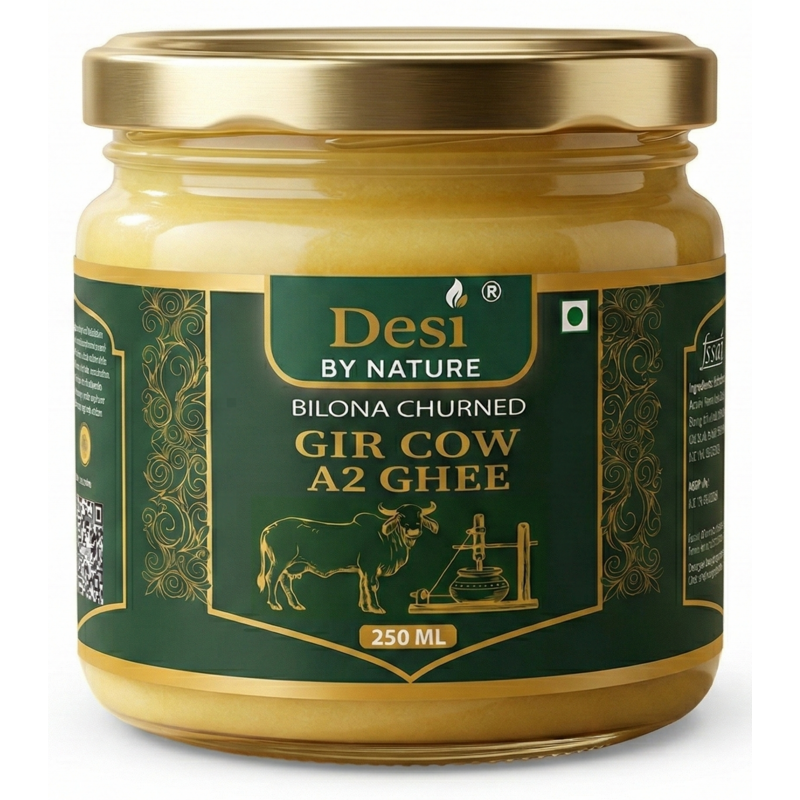
Two questions arrive constantly: "my ghee has gone grainy, has it spoiled?" and "my ghee is completely smooth, is it fake?"
The answer to both is no. Here is what the texture is actually telling you.
Ghee is not one fat
Milk fat is a mixture of many different triglycerides, and they do not all solidify at the same temperature. Some set at fairly high temperatures, others stay liquid until much colder.
When ghee cools, the higher-melting fractions crystallise first while the rest is still liquid. Those crystals are the grains. The rate of cooling determines how large they get:
- Slow cooling gives the crystals time to grow into large, distinct grains. This is the classic danedar texture.
- Rapid cooling produces many tiny crystals at once, and the result reads as smooth and uniform.
Same fat, same jar, different texture, purely from how quickly the heat left it.
Why traditional ghee is more often grainy
Ghee made in small batches and left to cool naturally in its container cools slowly, so it grains. Industrial ghee is often cooled quickly and sometimes mechanically worked while setting, which produces a deliberately smooth, spreadable product with a consistent appearance on shelf.
Grain is therefore associated with traditional small-batch production. That association is real, and it is why graininess became a folk marker of quality.
But grain is not proof
Here is the part usually left out of the marketing. Graininess can be induced. A producer who wants a danedar appearance can control cooling to get one, regardless of whether the ghee was churned from curd or separated from cream.
So grain tells you something about how the ghee was cooled. It does not, by itself, tell you:
- Whether it came from A2 or A1 milk
- Whether it was churned from curd or from cream
- Whether anything has been added to it
Treat it as one signal among several, not as a verdict.
Why your jar changes through the year
Ghee has no single melting point. It softens across a range, and Indian room temperature crosses that range seasonally.
In summer your ghee will very likely be liquid or nearly so. In winter it will be firm and probably grainy. The same jar can do both within a few weeks. Neither is a defect, and a ghee that stays identically soft and spreadable in a Delhi January and a Chennai May is worth a second look, not less.
What actually indicates a problem
Texture is not how you detect spoiled ghee. These are:
- A sour or sharply rancid smell. Ghee smells nutty and rich. Sour or paint-like is not right.
- Visible mould, which almost always means water got in, usually from a wet spoon.
- A bitter or metallic taste.
The single most useful storage habit is a dry spoon, every time. Ghee keeps for months at room temperature because it contains almost no water; introducing water is what ends that.
Our ghee is cooled slowly in small batches, so most jars set grainy in cooler months. It carries FSSAI licence 11525079000402. See the ghee.