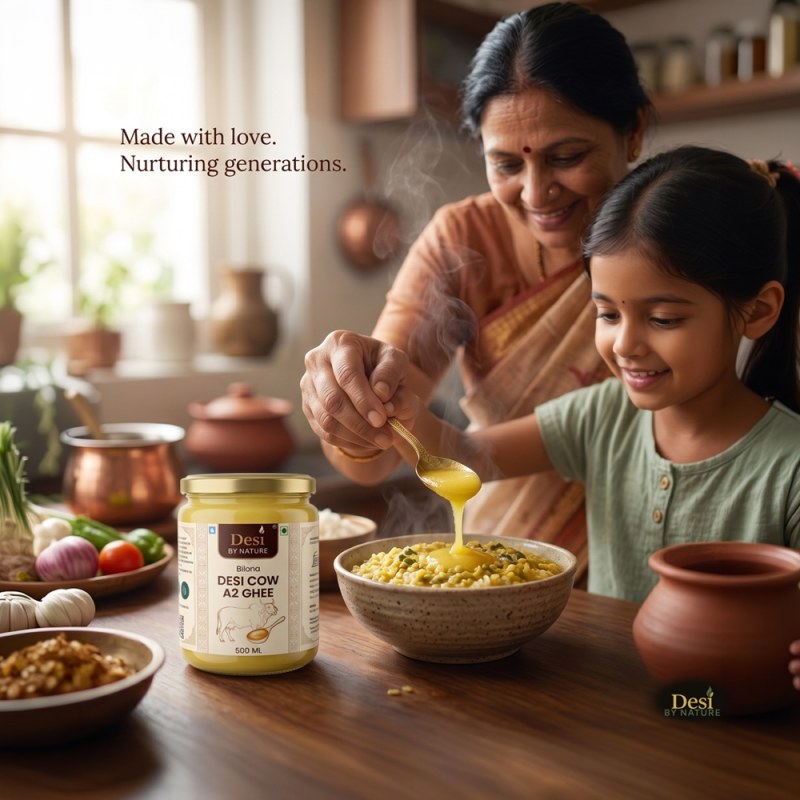
Ask almost any Indian grandmother how to feed a baby starting solids, and ghee will come up within the first minute. A few drops stirred into rice, dal or mashed vegetables has been standard practice in Indian homes for generations. Here is how families traditionally use it, some simple ideas, and the sensible cautions that go with any conversation about babies and food.
First, the important part: every baby is different. Your paediatrician knows your child's growth, health and any allergies. Please treat this as general information about common practice, not medical advice, and check with your doctor before introducing new foods.
When families usually start
Current paediatric guidance in India and internationally is to breastfeed exclusively for around the first six months, and then begin complementary foods alongside continued breastfeeding. Ghee is typically introduced as part of those first foods, not before.
Why families add ghee
Traditionally, ghee is added to baby food for a few practical reasons:
- Energy. Babies have small stomachs and high energy needs. A little fat makes a small serving more filling and energy-dense. Dietary fat is an important part of infant diets, which is why paediatric advice generally does not restrict fat for young children the way it may for adults.
- Texture. A drop of ghee makes mashed food smoother and easier to swallow.
- Taste. Plain rice or dal becomes more appealing, and many babies simply eat better.
- Fat-soluble nutrients. Some vitamins in vegetables are fat-soluble and are better absorbed when eaten with some fat.
How much
Traditional practice starts very small: a few drops, or about a quarter teaspoon, in a serving, increasing gradually as the baby eats more. By the time a child is eating regular family meals, half to one teaspoon in a meal is common. Your paediatrician can tell you what suits your child.
Simple first foods with ghee
Rice and moong dal khichdi. Cook rice and yellow moong dal together very soft with a little turmeric and plenty of water. Mash well. Stir in a few drops of ghee. This is often the very first food in Indian homes.
Mashed vegetables. Steam carrot, pumpkin, potato or sweet potato until very soft. Mash and add a few drops of ghee.
Ragi porridge. Cook ragi flour in water until smooth and thick. Add a little ghee. Some families add mashed banana for sweetness.
Suji kheer, without sugar. Roast semolina in ghee, cook in water or, for older babies as advised, milk, until soft.
Dal ka pani. The thin water from well-cooked dal, with a drop of ghee, is a traditional early food.
Sensible cautions
- Introduce new foods one at a time and watch for any reaction over a few days.
- No salt or sugar for young babies. Common guidance is to avoid adding salt or sugar in the first year.
- No honey before one year. Honey carries a risk of infant botulism.
- Milk allergy. Ghee contains only traces of milk protein, but traces are not zero. If there is any family history of milk allergy, or your baby reacts to dairy, speak to your doctor first.
- Freshness and hygiene. Use a clean, dry spoon. Use a small jar for baby food and do not use ghee that smells sour or rancid.
- Moderation. Ghee adds energy. More is not better, and it should not replace other foods.
Choosing ghee for a baby
Parents understandably want the most trustworthy ghee they can find for this. The practical checks are the same as for any ghee: one ingredient, a valid FSSAI licence number, a recent packing date, and ideally a brand that can show you a lab report. We wrote about how to choose good ghee in more detail.
Many families keep a separate small jar just for the baby, opened only with a clean spoon, so it stays fresh and uncontaminated.
A 250 ml jar of A2 Gir Cow Ghee is a size many parents choose for this. Every batch is tested by a NABL-accredited lab, and we are happy to share the report for your batch.