Twenty years ago most families bought ghee one of two ways: from the dairy down the road, or in a tin with a familiar logo. Today a single supermarket aisle can hold thirty jars, each promising to be purer, more traditional or more "desi" than the one beside it. The words have multiplied faster than the ways of checking them.
This is the checklist we would hand a friend who asked us what to look for. None of it needs a laboratory. Most of it takes less than a minute.
1. Start with the ingredient list
Good ghee has one ingredient. It may be written as "milk fat", "cow milk fat" or simply "ghee", but there should be nothing after it. If you see added flavour, colour, antioxidants or "vegetable fat", you are not holding pure ghee, whatever the front of the pack says. Blended products are legal when they are declared, and some are sold very cheaply for exactly that reason. They are a different product.
2. Find the FSSAI licence number
Every packaged food sold in India has to carry a 14-digit FSSAI licence or registration number. It tells you which business is legally responsible for what is inside. A missing number is a reason to put the jar back. A present one is not a guarantee of quality, but it does mean somebody can be held to account, and you can look the number up on the FSSAI's public licence search if you want to see whose it is.
3. Decide which kind of ghee you actually want
There are a few honest distinctions worth knowing before you compare prices:
- Cow or buffalo. Cow ghee is usually yellow and lighter in flavour. Buffalo ghee is whiter and heavier. Neither is fake; they are different fats from different animals.
- Bilona or cream-separated. Bilona ghee is churned from curd. Most commercial ghee comes from cream separated by machine. We have written about the real difference between the two, and it comes down to flavour, milk used and price.
- A2 or not. "A2" refers to a protein in the milk the ghee was made from, typically from indigenous Indian breeds. Our explainer on A2 and A1 milk sets out what that label can and cannot tell you.
Once you know which of these matters to you, half the jars on the shelf drop out of consideration, and the comparison gets much easier.
4. Do the price arithmetic
Price is the most underrated clue in the aisle. Bilona ghee uses far more milk per litre than cream ghee, commonly somewhere around 25 to 30 litres, and milk is not cheap anywhere in India. If a jar calls itself bilona and costs about the same as an ordinary brand, the numbers do not work. Somebody is either losing money on every jar or the word on the label is doing more work than the process behind it.
The reverse is not automatically true. A high price does not prove anything by itself. But an implausibly low one is one of the few signals that is hard to fake.
5. Look at the packaging
Ghee keeps well, but fat picks up odours and reacts to light and heat over time. Glass is inert and lets you see the texture. Food-grade steel is sturdy and suits large quantities. Thin plastic tubs are cheap and convenient, and they are also the most likely to pass along smells from a warm warehouse. It is not a dealbreaker, but it tells you something about where the brand chose to spend.
6. Check the dates and the batch
Look for a packing date, a best before date and a batch number. Most ghee is labelled best before 9 to 12 months from packing. A jar that has already spent most of that life on a shelf will still be safe, but it will not smell the way it did when it was fresh. The batch number matters for a different reason: it is the only way a brand can trace a complaint back to a specific production run.
7. Open it and trust your nose
The first time you open a jar at home, warm half a teaspoon in a small pan. Good ghee smells nutty and rich, and bilona ghee has an extra slightly tangy, cultured note. Stale ghee smells flat or faintly like old crayons. Ghee with added oil tends to smell of very little at all. Your nose will not detect every problem, but it is better at this than most people give it credit for.
8. Do not rely on a single home test
There are some useful checks you can run in a kitchen, and we have covered five of them in detail. What they cannot do is prove purity. Clever adulteration is designed to pass the popular tests. Treat them as a way to catch obvious problems, not as a certificate.
9. Ask the brand a direct question
A good seller can tell you, in plain language, where the milk comes from, whether it is set into curd before churning, and whether batches are sent to an independent lab. Vague answers are informative. So are brands that are happy to show you a test report without being chased for it.
A short version for the shop floor
- One ingredient.
- A valid FSSAI number.
- A price that makes sense for the process claimed.
- A recent packing date and a batch number.
- A smell you would be happy to cook with.
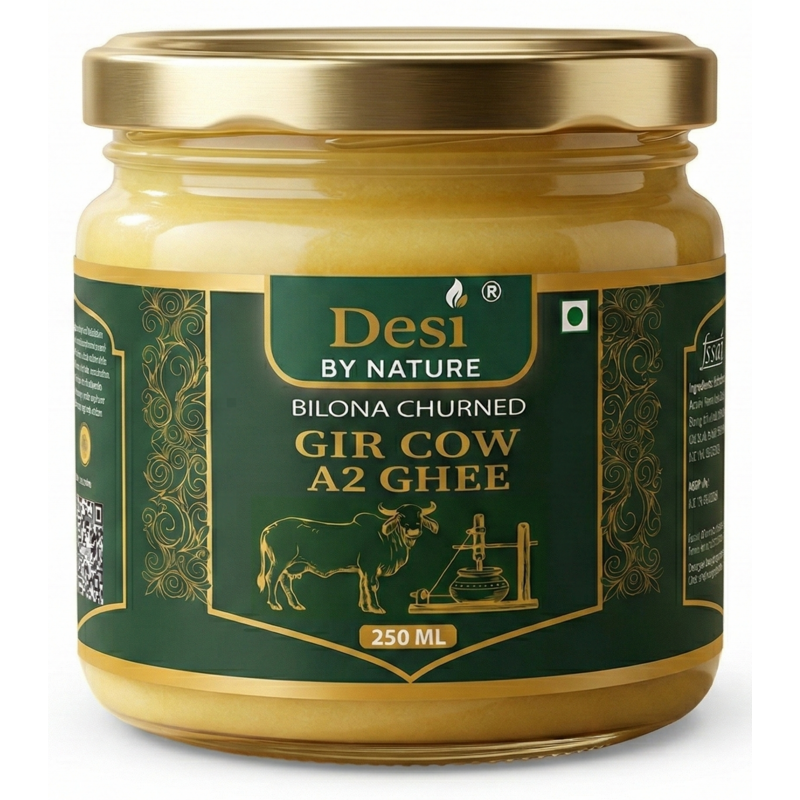
If you would like a reference point, our A2 Gir Cow Ghee is curd-churned, packed in glass, and every batch goes to a NABL-accredited lab before it ships. We would still rather you ran this checklist on it than took our word for it.