If you grew up in an Indian city in the 1990s, you probably remember the shift. Ghee was quietly moved to the back of the cupboard, and refined sunflower, soybean or rice bran oil took its place by the stove, sold on the promise of being "light" and "heart friendly". Today a lot of those same families are bringing ghee back. It is worth looking at what the two fats actually are, without swinging from one extreme to the other.
How each is made
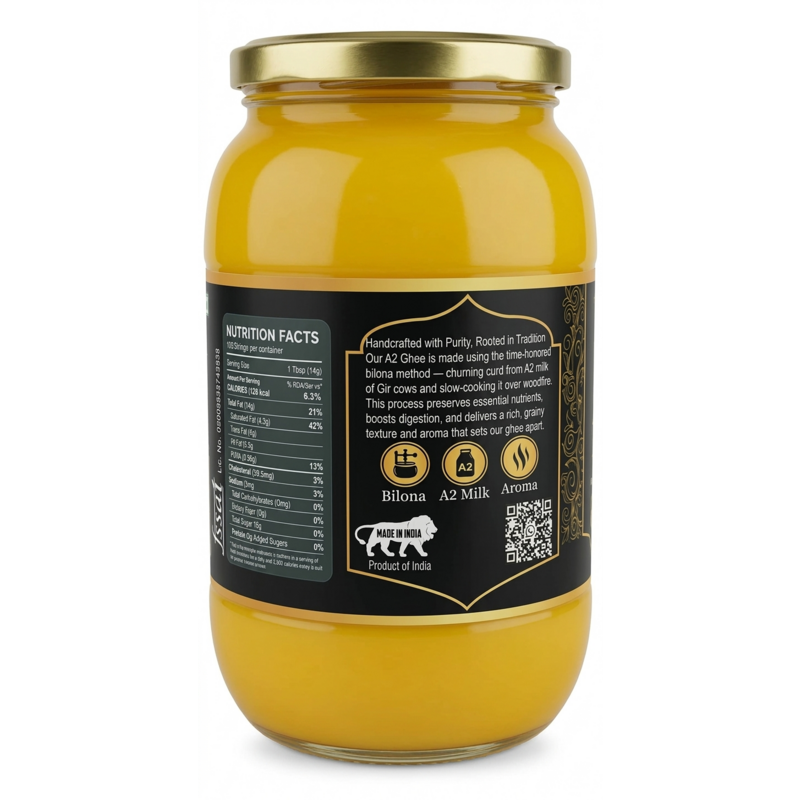
Ghee is butter cooked until its water evaporates and milk solids brown, then strained. That is all. Bilona ghee adds a curd-setting and churning step before that. There are no chemical processing steps.
Refined vegetable oil goes through a longer industrial process. Seeds are pressed, and often the remaining oil is extracted with a food-grade solvent. The crude oil is then typically degummed, neutralised, bleached and deodorised at high temperature. The result is a clear, neutral oil with a long shelf life. These steps are regulated and the finished oil is safe to eat; they also remove much of the seed's original flavour and some of its natural compounds.
Flavour
This is not close. Refined oils are designed to taste of nothing. Ghee tastes nutty and rich, and it carries the aroma of spices beautifully. In dishes where fat is part of the flavour, such as dal tadka, khichdi, halwa and rotis, ghee makes a clear difference. In a heavily spiced curry or for deep frying pakoras, a neutral oil can be a sensible and economical choice.
Cooking stability
Ghee is mostly saturated and monounsaturated fat, with a small amount of polyunsaturated fat. Many refined seed oils, such as sunflower and soybean, are high in polyunsaturated fat. Polyunsaturated fats are more prone to oxidation when heated for long periods or reused. Both ghee and most refined oils have high smoke points, but ghee tends to hold up better to repeated heating in the kind of tempering and slow cooking Indian kitchens do.
This is about how the fats behave in a pan. It is not the same as saying one is better for your body.
What about health?
Here, honesty matters more than marketing, in both directions.
Ghee is a saturated fat, and health authorities around the world advise keeping saturated fat intake moderate. Refined seed oils are not a health food either, and diets overly dependent on a single oil are not ideal. Indian dietary guidelines have for some years recommended using a variety of fats and oils rather than one, and keeping total visible fat intake moderate.
So the sensible answer is not "ghee good, oil bad" or the reverse. It is to use a combination, use them for what they do well, and not use too much of any of them. If you have a specific health condition, your doctor or dietitian is the right person to set limits for you.
Cost
Refined oil is much cheaper per litre. A good bilona ghee costs many times more. That is one of the best practical reasons to use ghee where you taste it, rather than for everything.
A practical way to use both
- Ghee: tadka, rotis and parathas, rice dishes, khichdi, sweets and halwa, finishing a dish, anything where its flavour is the point.
- Cold-pressed or regional oils: mustard oil for Bengali and Punjabi dishes, coconut oil for Kerala cooking, groundnut or sesame oil for Tamil and Gujarati dishes. These carry their own flavour and tradition.
- Refined oil: deep frying in large quantities, or dishes where you want no flavour at all.
We compare ghee with coconut and mustard oils in a separate piece.
The short version
Refined oil is cheap and neutral. Ghee is flavourful, stable and traditional, and more expensive. Neither deserves to be banished or worshipped. Use each where it earns its place.
For the places where ghee earns it, our Desi Cow A2 Ghee is made by the traditional bilona method, with nothing added.