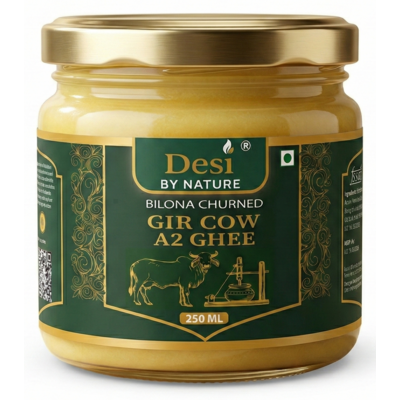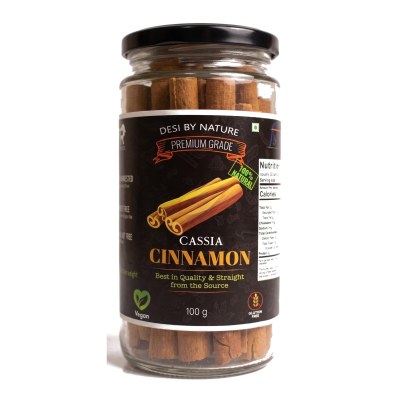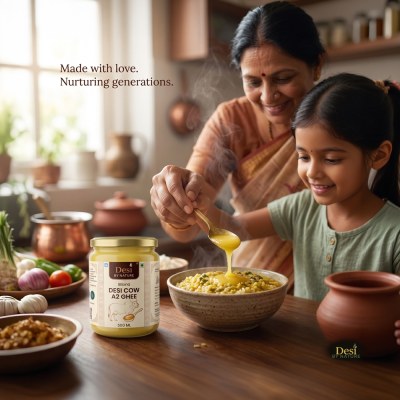
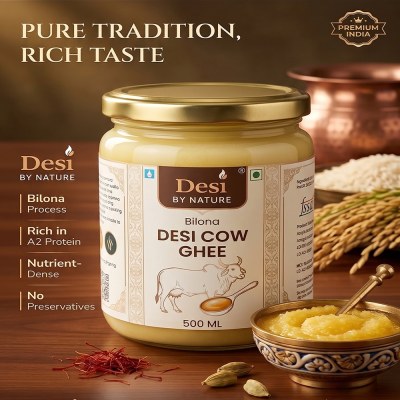
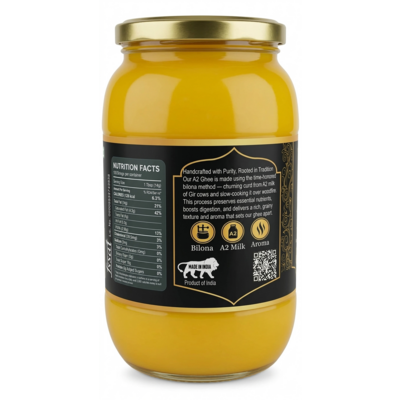
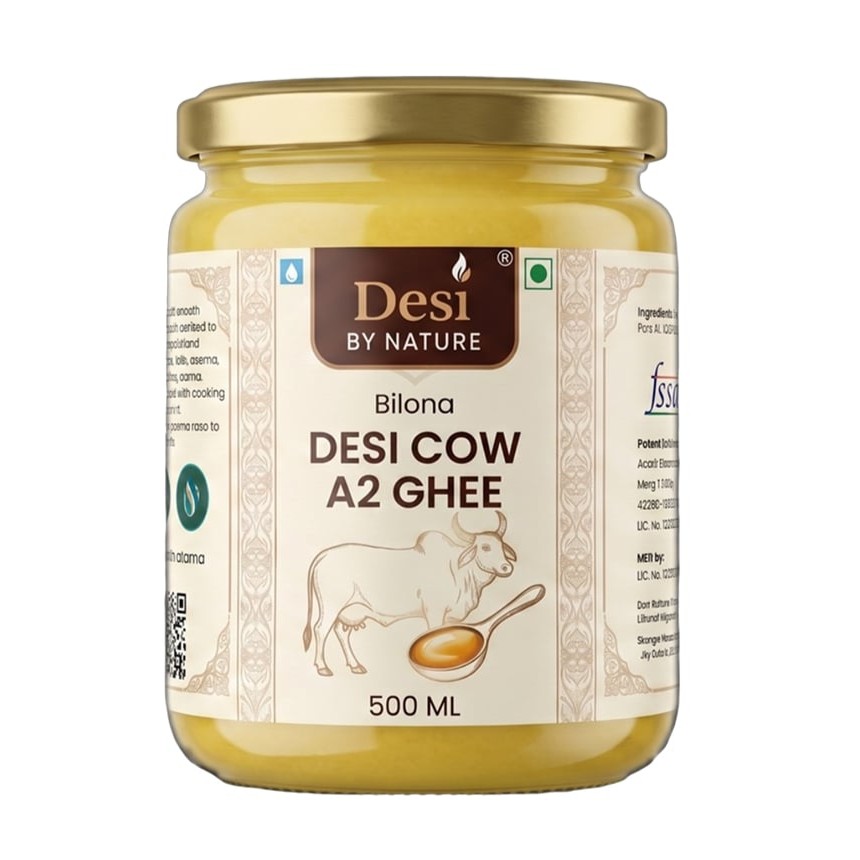
Bilona method, lab-tested, from the milk of desi indigenous cows. One ingredient, nothing added.
Lab-tested bilona ghee · packed in glass jars and steel dolchis
“Very authentic and tastes very good. Will buy again.”
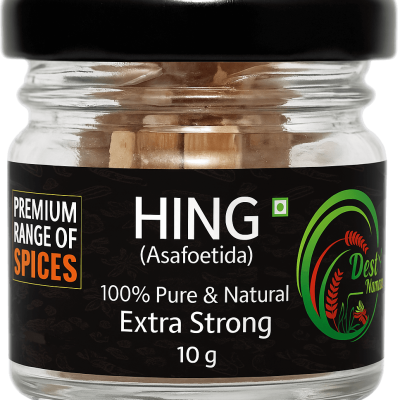
— Janardan S., verified buyer · all 6 reviewsGhee, hing and haldi are what a tadka is made of. Add them together in one tap.
We work only with dairies that still do it this way, and have the ghee lab-tested before it carries our name.
Good ghee announces itself before it reaches the plate. Warm a spoonful and the kitchen fills with a nutty, faintly caramel aroma; let it cool and it settles into soft, grainy crystals. None of that is added. It comes from how this ghee is made: from curd, churned the slow way, and cooked until the butter turns gold.
Where it comes fromOur Desi Cow Ghee comes from the milk of desi indigenous cows. Native Indian breeds are known for giving A2 milk, and that is what the "A2" on the jar refers to: the milk this ghee begins as.
How it is madeMuch of the ghee on supermarket shelves skips the first two steps. Cream is separated from the milk by machine and heated straight into ghee. Churning curd takes longer and recovers less fat, but it is what gives bilona ghee its fuller aroma and granular body.
What is in the jarOne ingredient: A2 desi cow milk fat. No preservatives, colours, flavours or vegetable fats. The ghee is lab-tested for purity before we sell it.
Colour and textureExpect some variation from batch to batch. The colour moves with the season and with what the cows are eating, anywhere from pale straw to deep yellow. The texture follows the weather: fully liquid on a hot day, soft and grainy (danedar) when it is cooler. Both are normal for ghee made without additives.
In your kitchen| Bilona ghee (this jar) | Cream-method ghee | |
|---|---|---|
| Starts as | Curd set from whole milk | Cream separated from milk by machine |
| Churning | Curd churned into makkhan | None |
| Aroma | Deep, nutty, lightly caramelised | Milder |
| Texture when set | Grainy | Usually smooth |
| Milk per jar | More, as churning curd recovers less fat | Less |
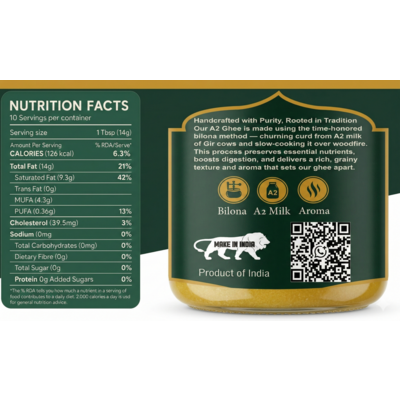
| Per serving (1 tbsp, 14 g) | Amount |
|---|---|
| Energy | 126 kcal |
| Total fat | 14 g |
| Saturated fat | 9.3 g |
| Monounsaturated fat | 4.3 g |
| Polyunsaturated fat | 0.36 g |
| Trans fat | 0 g |
| Cholesterol | 39.5 mg |
| Sodium | 0 mg |
| Carbohydrates | 0 g |
| Protein | 0 g |
Best before 12 months from the date of packing. Keep it closed, in a cool, dry place away from direct sunlight, and always use a clean, dry spoon. It does not need refrigeration.
Every jar starts as a large quantity of milk. That milk is first set into curd, and churning curd recovers less butter than a cream separator would, so more milk goes into each jar. The butter is then cooked slowly rather than rushed, the ghee is lab-tested, and the jars are glass rather than plastic. The price reflects that process.
It describes the milk, not the ghee. Cow's milk contains a protein called beta-casein, which comes in two main forms, A1 and A2, and desi indigenous breeds give milk with the A2 form. Ghee is almost pure butterfat, and clarification removes nearly all of the milk proteins, which is why the label shows 0 g protein. So "A2 ghee" means ghee made from A2 milk, from desi cows. It is not a source of protein.
Both are made by the bilona method, from curd, and both begin as A2 milk. The difference is the herd. Our Gir Cow Ghee is made only from the milk of Gir cows, a single breed, while this ghee is made from the milk of desi indigenous cows. Gir milk is scarcer and costs more, which is why the two are priced differently. Choose Gir if a single-breed ghee matters to you, and this one for an everyday bilona ghee.
Because that is how ghee was traditionally made, and the difference shows in the jar. Setting milk into curd and churning it develops flavour that cream alone does not have, and cooking the resulting butter slowly gives bilona ghee its aroma and grain. The cream route is faster and gets more ghee from the same milk, which is why most large-scale ghee is made that way.
Yes. The water and milk solids are cooked out while the ghee is made, so it does not scorch the way butter does. That makes it well suited to tadka, sautéing and shallow frying. As with any cooking fat, lower the flame if it starts to smoke.
No. The label lists a single ingredient, A2 desi cow milk fat. There are no preservatives, colours, flavours or vegetable fats. Its 12-month shelf life comes from ghee's naturally very low moisture, not from anything added.
The 500 ml jar suits most homes that use ghee a few times a week, and you will finish it comfortably within its shelf life. If ghee goes into your cooking every day, the 1 litre jar costs less per ml. The 1 litre jar is also the best value per ml of the four sizes. The 2.5 litre and 5 litre dolchis are for households that would rather buy once and keep a stock, for festival cooking, or for anyone who wants the steel dolchi itself; they cost a little more per ml than the 1 litre jar. With either dolchi, decant a smaller amount for daily use and keep the dolchi closed.
Not reliably, which is why we have our ghee lab-tested before we sell it. Popular kitchen tests, such as melting a spoonful in your palm or watching how it sets in the fridge, can be passed by well-made adulterated ghee. What you can check is an FSSAI licence number on the label (ours is 11525079000402), a single-ingredient list, and the aroma when it is warmed, which is hard to imitate. If you have a question about a particular jar, send us the batch number from its label on WhatsApp.
No. Ghee turns liquid in summer and solid or grainy in winter. This is normal and a sign of no additives. Why that happens, and the three signs a jar has actually turned.
Pay online through Razorpay (UPI, cards, net banking or wallets), or choose Cash on Delivery on orders from ₹699 to ₹4,999. With Cash on Delivery you pay 20% of the order (at least ₹299) plus a ₹49 handling fee online, and the rest to the courier at your door, in cash or by UPI. Paying online in full skips the handling fee and takes ₹10 off the goods. Most metro PIN codes get delivery in 3 to 4 working days, tier 2 and 3 cities in 3 to 7 days, and you can check yours above. Ghee always ships free, at every size, and so does anything ordered with it. Spices on their own ship free over ₹999.
Keep at room temperature with a dry spoon, refrigeration optional. Glass keeps the aroma true for up to a year. See the date on your jar. Full storage guide.
A litre is about 65 tablespoons. A household using one tablespoon a day finishes it in about two months; three tablespoons a day, which is easy with a tadka, rotis and a sweet, in about three weeks. For the best aroma, finish a jar within two to three months of opening it. Our guide to how much ghee a household actually uses works out which size fits your kitchen.
Many Indian families add a few drops of ghee to a baby's food once solid food begins, at around six months. Every child is different, so check with your paediatrician first, especially if there is any history of milk allergy, since ghee can contain traces of milk protein.
Good quality ghee
Verified buyerphenomenal taste
Verified buyernice aroma and tastes very good
Verified buyerVery authentic and tastes very good. Will buy again.
Verified buyerauthentic ghee, quite satisfied with the ghee.
Verified buyerThe product is good but very price is high
Verified buyer