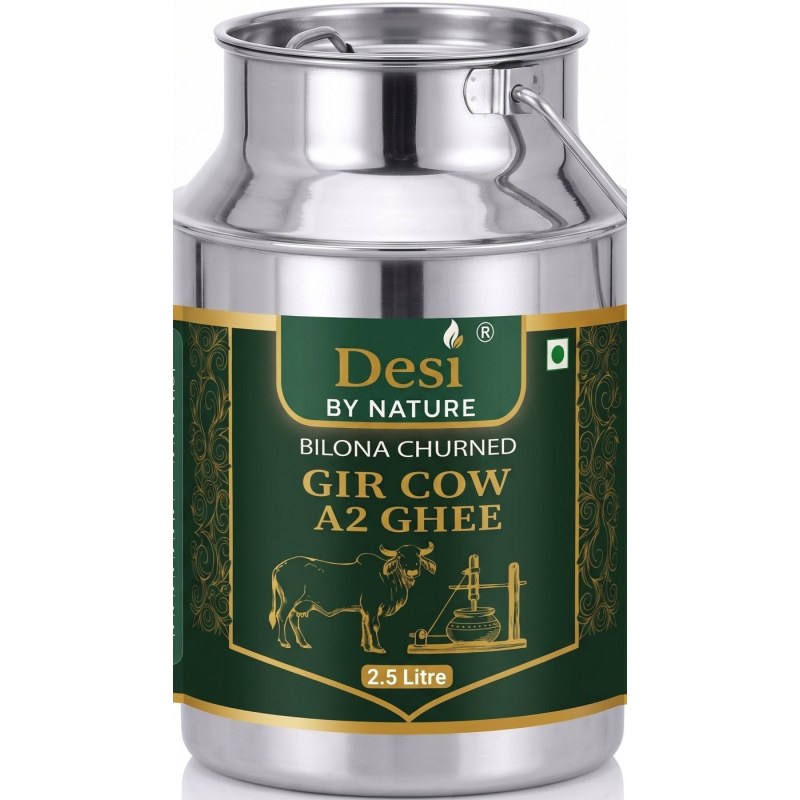
We sell two ghees that look similar on paper. Both are A2. Both are made by the bilona method. Both come in glass jars and steel dolchis. One costs noticeably more than the other. The most common question we get on WhatsApp is some version of "what is actually different, and which one should I buy?"
Here is the honest answer.
What they have in common
Both ghees start as A2 milk from indigenous Indian cattle. In both cases the milk is set into curd, the curd is churned into makkhan, and the makkhan is slowly cooked into ghee. Neither has anything added, and both are lab-tested. Nutritionally, they are the same kind of food: almost pure milk fat, with the same calories per spoon.
If you are switching from an ordinary cream-separated supermarket ghee, either of them will taste and smell quite different from what you are used to, because of the curd-churning step. That difference is bigger than the difference between the two of them.
The difference: which cows
A2 Gir Cow Ghee is made only from the milk of Gir cows, a single indigenous breed from Gujarat's Saurashtra region, known for its distinctive domed forehead and long, curled ears. Gir cattle are prized in Indian dairying, and their milk is in high demand and short supply.
Desi Cow A2 Ghee is made from the milk of desi indigenous cows more broadly, rather than one specific breed. It is still A2 milk from native cattle, still churned from curd.
That is the whole distinction. It is not a matter of one being "real" and the other not. It is single-breed milk versus mixed indigenous milk.
Why the Gir ghee costs more
Mostly because the milk costs more. Gir milk commands a premium across India, and a litre of bilona ghee needs a lot of milk. On top of that, our Gir ghee comes from Gir cow dairies we have vetted, and every batch is sent to a NABL-accredited laboratory before we sell it. Those steps cost money, and that cost is in the jar.
Does it taste different?
Side by side, many people notice that the Gir ghee is slightly richer and rounder, and it tends to be a deeper yellow. Others struggle to tell them apart once the ghee is in a dal. Colour and flavour in any ghee also shift with the season and with what the animals are eating, so a winter batch of one can resemble a summer batch of the other.
We would not claim one is healthier. There is no good evidence that Gir milk fat behaves differently in the body from the milk fat of other indigenous breeds, and we are not going to invent some.
Which one we would suggest
Choose the A2 Gir Cow Ghee if:
- A single-breed, traceable source matters to you.
- You want a single-breed ghee with a batch lab report for every jar.
- Ghee is something you eat on its own: a spoon over hot rice, on a roti, in a child's food.
- You are buying a gift and want the best jar we sell.
Choose the Desi Cow A2 Ghee if:
- You want bilona ghee for everyday cooking and go through a lot of it.
- Most of your ghee ends up in tadkas, parathas and sweets, where spices are doing a lot of the talking.
- You are feeding a large family or buying in bulk.
Plenty of our customers keep both: a small jar of Gir ghee on the table, and a larger jar or a dolchi of Desi Cow ghee by the stove. It is a sensible way to spend less without giving up on bilona ghee for cooking.
Sizes, briefly
The Gir ghee comes in 250 ml, 500 ml and 1 litre glass jars, plus 2.5 and 5 litre dolchis. The Desi Cow ghee comes in 500 ml and 1 litre jars and the same two dolchi sizes. In both ranges the 1 litre jar costs less per ml than the smaller jars, and ghee ships free at every size.
If you are still unsure, start with a small jar of A2 Gir Cow Ghee and a 500 ml jar of Desi Cow A2 Ghee, and taste them warm, side by side. It is the only comparison that really settles it.