A few years ago, very few ghee brands shared test reports. Now "lab tested" is a common claim, and some brands will send you a PDF if you ask. That is a good development. It is also easy to be reassured by a document full of numbers without knowing whether it says what you think it says.
This guide is about reading the report as a document: who made it, what it covers and what to check. For the meaning of each technical parameter, our separate guide to FSSAI standards for ghee goes line by line.
1. Who issued it
Look at the letterhead. The report should come from an independent testing laboratory, not from the brand itself. An in-house quality check has its uses, but it is not independent verification.
Then look for accreditation. In India, the relevant body is NABL, the National Accreditation Board for Testing and Calibration Laboratories. An accredited lab has been assessed for its methods, equipment and competence. Reports from accredited labs often carry the NABL symbol and a certificate number. You can check the lab against NABL's public directory.
Some labs are also recognised by FSSAI for food testing. Either way, a named, accredited, independent lab carries much more weight than an unnamed one.
2. What was tested
The report should describe the sample: "ghee", "cow ghee", ideally with the brand and product name. Check that it is the product you are buying. A report for a brand's cow ghee tells you nothing about its buffalo ghee or a different range.
3. Which batch
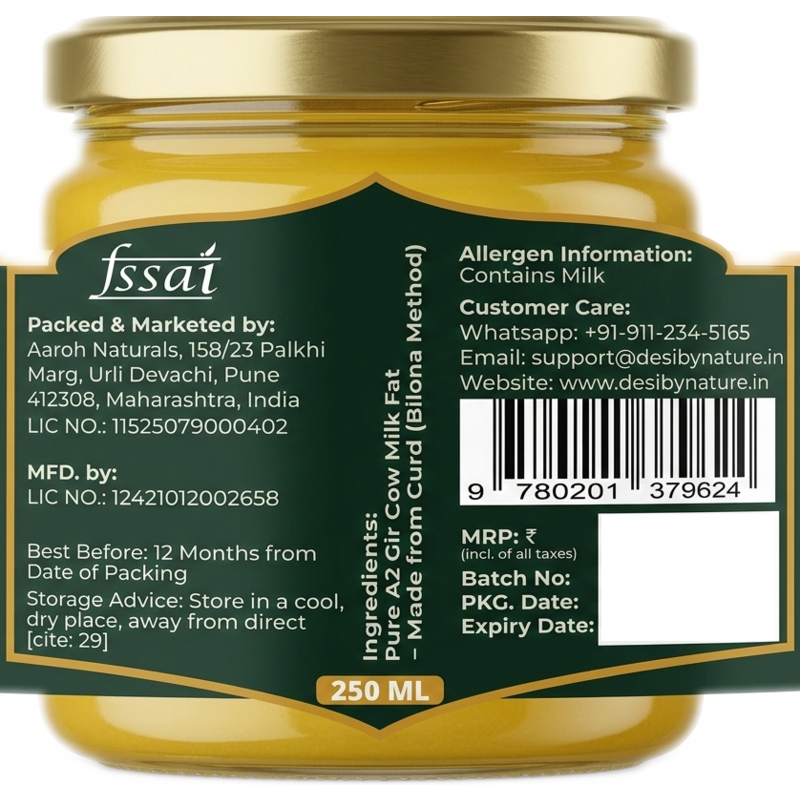
This is the single most important check, and the one most often missing. A good report, or the brand's summary of it, links the sample to a batch or lot number. Compare it with the batch number printed on your jar.
A report without any batch reference proves that one sample, at some point, passed. It does not tell you about the jar in your hand.
4. When
Look for three dates: when the sample was received, when testing was done and when the report was issued. A report from two years ago is history. Ghee is made in batches from milk that changes with seasons, so recent reports are much more meaningful than old ones.
5. Who sent the sample
Reports usually show the customer's name, which will normally be the brand. That is fine, but it means the brand chose which sample to send. This is why regular, batch-linked testing matters more than a single impressive certificate.
6. The parameters tested
A basic ghee report typically includes some combination of:
- Moisture
- Free fatty acids (FFA), which relate to freshness and rancidity
- Butyro-refractometer (BR) reading
- Reichert-Meissl (RM) value and sometimes Polenske value, which relate to the characteristic fatty acids of milk fat
- Baudouin test, an indicator used for vegetable oil adulteration, explained in our Baudouin test piece
- Sometimes tests for starch, colour or other adulterants
More comprehensive reports may include fatty acid profiles, sterol analysis or tests for contaminants. A report does not need all of these to be useful, but it should cover the core parameters that indicate genuine milk fat.
7. Results against limits
Each result should appear alongside the legal or specified limit, and ideally a remark saying whether it conforms. Read across the row: result, unit, limit, method. If a report shows results without limits, you are being asked to trust that the numbers are good.
8. The method column
Accredited reports cite the testing method, for example an FSSAI manual or a BIS standard. You do not need to understand the method. Its presence is a sign the lab is following a recognised procedure.
9. Signatures and disclaimers
Reports are signed by an authorised signatory. Most also state that results relate only to the sample tested. That is standard wording and not a warning sign; it is simply true.
Red flags
- No lab name or no accreditation details.
- No batch or lot reference.
- A report more than a year old presented as current.
- Results with no limits shown.
- A cropped screenshot rather than the full document.
- Reluctance to share the report at all.
What a report cannot tell you
A clean report shows the sample met the standards tested. It does not prove how the ghee was made. A cream-separated ghee and a bilona ghee can both pass the same tests, and a report will not show whether the milk came from Gir cows. Testing answers "is this genuine, fresh milk fat within limits?" very well. It answers "is this the traditional product described on the label?" only partly.
Every batch of our A2 Gir Cow Ghee is tested by a NABL-accredited lab before it ships. You can see more on our lab reports page, or ask us for the report matching the batch number on your jar.