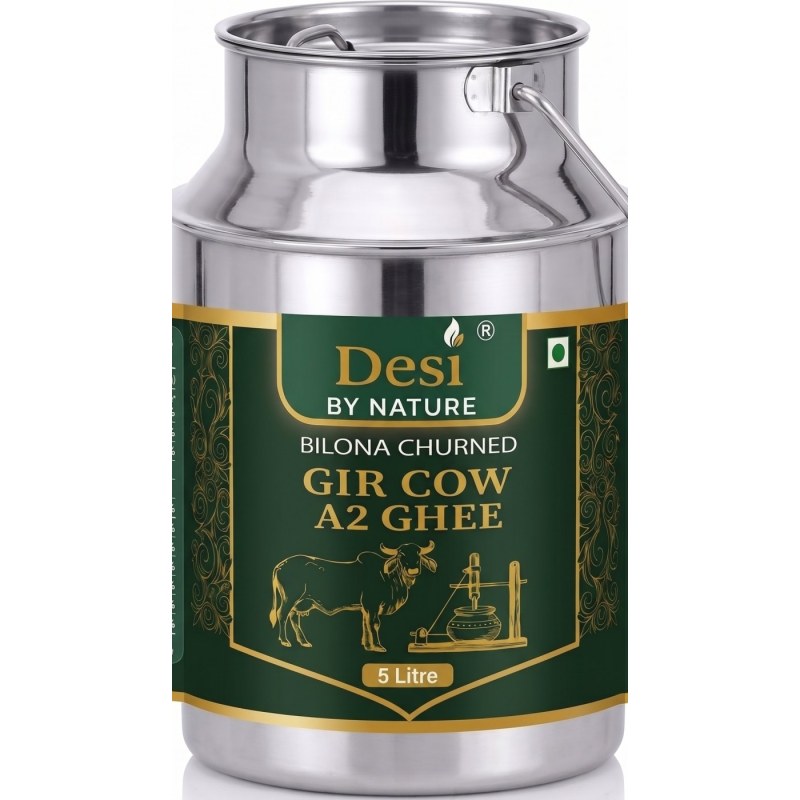
A dolchi is the steel milk-can shaped container many Indian families remember from their grandparents' kitchens. It is making a comeback for ghee, and we now sell our ghee in 2.5 and 5 litre dolchis alongside our jars. People reasonably ask whether buying that much at once makes sense. The answer depends on your household, and we would rather give you the actual numbers than a sales pitch.
The numbers, calculated honestly
Using our prices at the time of writing:
A2 Gir Cow Ghee
- Five 1 litre jars: 5 × ₹1,698 = ₹8,490
- One 5 litre dolchi: ₹8,999
- The dolchi costs about ₹500 more
- Two and a half litres in 1 litre jars: about ₹4,245
- One 2.5 litre dolchi: ₹4,999
- The dolchi costs about ₹750 more
Desi Cow A2 Ghee
- Five 1 litre jars: 5 × ₹1,299 = ₹6,495
- One 5 litre dolchi: ₹7,499
- The dolchi costs about ₹1,000 more
- Two and a half litres in 1 litre jars: about ₹3,248
- One 2.5 litre dolchi: ₹3,999
- The dolchi costs about ₹750 more
So for both ghees, a dolchi costs more than the same quantity bought in 1 litre jars. With a dolchi you are paying for a sturdy steel container you will keep for years, one large stock and fewer orders, not for a lower price. If saving money is the goal, buy 1 litre jars.
When a dolchi makes sense
- You use a litre in three to five weeks. A 5 litre dolchi then lasts four to six months, comfortably within ghee's shelf life if stored well.
- You cook for a large or joint family.
- You have a festival, a wedding or a puja coming up that needs a lot of ghee for sweets and prasad.
- You want fewer orders and fewer glass jars to deal with.
- You like the dolchi itself. A food-grade steel dolchi with a lid and handle is useful for years after the ghee is gone, for milk, grains or storing another batch of ghee.
When it does not
- You live alone or as a couple and use ghee a few times a week. A 5 litre dolchi could take a year or more to finish, and the aroma will fade well before then.
- You have no cool, dark storage space. Keeping 5 litres of ghee next to a stove or in a sunny kitchen is not a good idea.
- You are trying a ghee for the first time. Buy a jar, make sure you like it, then commit.
How to store a dolchi of ghee
- Decant for daily use. Fill a clean, dry glass jar with a week or two's worth and keep the dolchi closed. Opening a large container every day lets in air and moisture.
- Always use a dry steel ladle to decant. Never a wet spoon, and never a spoon that has touched food.
- Keep it somewhere cool and dark. A cupboard away from the stove, the sink and exterior walls that heat up in the afternoon.
- Keep the lid on firmly. Ghee absorbs smells from spices and onions stored nearby.
- Warm gently if it sets hard in winter. Stand the dolchi in a basin of warm, not boiling, water for a few minutes. Do not heat the whole dolchi on a flame.
Stored this way, ghee keeps well for months. If you want the full detail, see our guide on storing bilona ghee.
A middle path
If 5 litres feels like a lot, split one with a relative or neighbour. It is an old habit in Indian households. If price is what matters most, though, buying a few 1 litre jars and sharing them is cheaper than splitting a dolchi.
You can see both sizes, with photos of the dolchis, on the A2 Gir Cow Ghee and Desi Cow A2 Ghee pages. Ghee ships free at every size.