Mysore pak was born in the royal kitchens of Mysore Palace, and it has been Karnataka's pride ever since. There are two broad styles. The traditional one is firmer, porous and slightly crumbly, with a honeycomb texture inside. The soft style, made famous by sweet shops in Tamil Nadu and Karnataka, is fudge-like and melts almost immediately in the mouth. Both are made of the same three things: besan, sugar and ghee. The ghee is not a minor ingredient. By volume, it is the largest one.
Ingredients
- 1 cup besan, sifted
- 1½ cups sugar
- ½ cup water
- 1½ to 2 cups ghee (1½ for firmer, 2 for soft)
- A pinch of cardamom powder (optional; not traditional in every home)
Before you start
- Grease a steel tray or cake tin with ghee.
- Keep the ghee hot in a small pan on a back burner. This matters.
- Have everything ready. Once you begin, you cannot leave the stove.
Method
- Roast the besan lightly (optional). Some cooks roast the besan in 2 tbsp ghee for 2 to 3 minutes until just fragrant, without colouring. Others skip this. It gives a slightly nuttier result. Set aside.
- Make the syrup. In a heavy, wide kadai, heat sugar and water until the sugar dissolves. Boil until it reaches a one-string consistency: take a drop between thumb and finger, pull them apart, and a single thread should form.
- Add besan. Lower the heat. Add the besan gradually while whisking constantly to prevent lumps.
- Add hot ghee, a ladle at a time. Once the besan is mixed in, add a ladle of hot ghee. It will sizzle and be absorbed. Stir continuously. Add another ladle as soon as the first is absorbed. Continue until all the ghee is in.
- Watch it foam. After most of the ghee is in, the mixture starts to bubble up, froth and turn lighter and more porous. It begins leaving the sides of the pan, and some ghee starts separating.
- Pour. For soft Mysore pak, pour as soon as it froths up and starts pulling away from the sides. For the firmer, porous style, cook 1 to 2 minutes longer until it turns a shade more golden and very frothy. Pour into the greased tray immediately. Do not spread or press it too much.
- Cut while warm. After 5 to 8 minutes, cut into squares while still warm. Let it cool fully before separating the pieces.
Why the ghee must be hot
Hot ghee hitting the besan and syrup mixture causes it to bubble and aerate, which gives Mysore pak its light, porous structure. Cold ghee cools the mixture, slows the cooking, and gives a dense, oily result.
The timing of the pour
This is the only real skill. Pour too early and the Mysore pak stays soft and greasy and will not set. Pour too late and it turns hard and brittle, and can taste burnt. The visual cues are froth, a lighter colour and the mass pulling away from the kadai. The first attempt is rarely perfect; the second usually is.
If it goes wrong
It will not set: it was poured too early. Return it to the kadai and cook a little longer.
It is rock hard: overcooked. It will still taste good crumbled over ice cream or eaten as a brittle.
About all that ghee
There is no light version of Mysore pak that tastes like Mysore pak. Some ghee will drain out as it sets; that is normal. This is a sweet where the quality of ghee is directly what you taste, so use the best you have, and enjoy one piece rather than five.
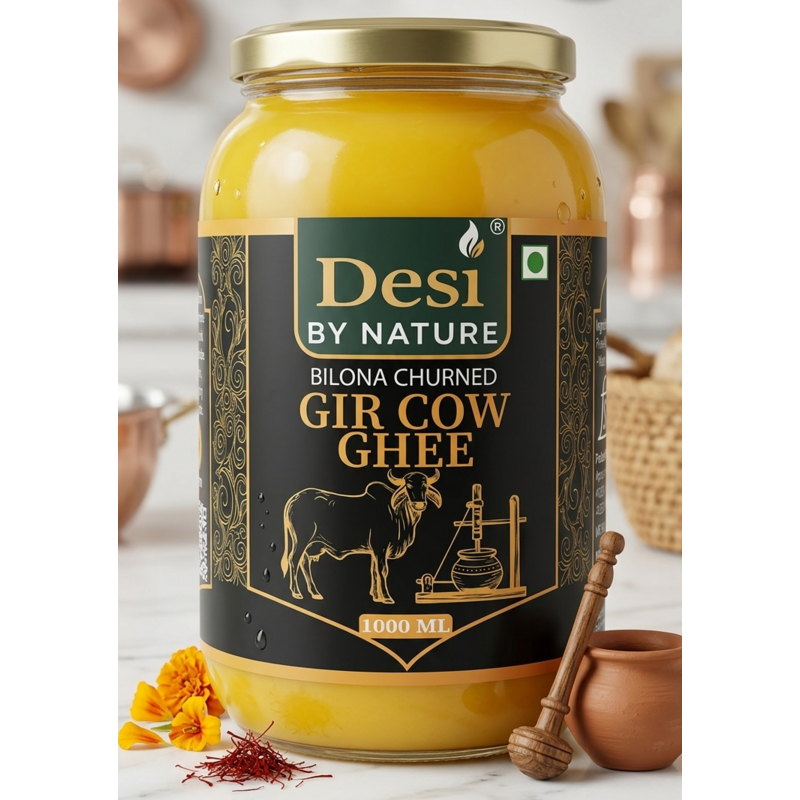
We make Mysore pak with A2 Gir Cow Ghee. For a sweet that is mostly ghee, it is worth it.