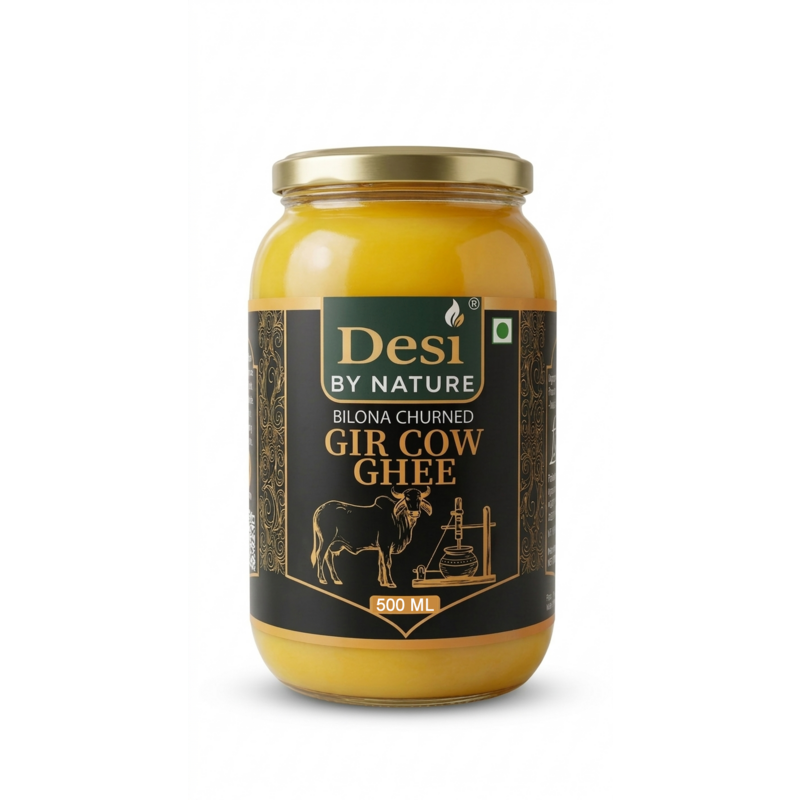
Search for ghee online and you will quickly be told that it has a "high smoke point" and is therefore "ideal for frying". It is a reasonable summary with a few things missing. Here is what smoke point actually is, what the numbers for ghee look like, and what it means at your stove.
What smoke point means
Every fat has a temperature at which it starts to give off a steady stream of visible smoke. That is its smoke point. Past it, the fat is breaking down: glycerol degrades into acrolein, which irritates the eyes and throat, and oxidation speeds up, creating off flavours and compounds you would rather not eat in quantity.
Smoke point is not a fixed physical constant like the boiling point of water. It varies with the purity of the fat, its free fatty acid content, how fresh it is and even how it is measured. That is why you see different figures quoted for the same fat.
Where ghee sits
Figures commonly cited for ghee fall somewhere around 230 to 250°C. Butter, by comparison, is usually quoted at roughly 150 to 175°C.
The difference is the milk solids. Butter contains milk proteins and sugars that burn at relatively low temperatures, which is why butter browns and then blackens quickly in a hot pan. Ghee is butter with those solids cooked out and strained away, leaving almost pure fat, so it tolerates much more heat before smoking.
For context, many refined vegetable oils sit in a similar range to ghee or higher, and unrefined oils such as cold-pressed mustard or virgin coconut oil tend to be lower. Numbers vary a lot by source.
What temperature does Indian cooking reach?
Less than people imagine, most of the time.
- A tadka is usually done at something like 160 to 190°C, hot enough to crackle cumin in seconds.
- Shallow frying and sautéing typically sits in the 160 to 190°C range as well.
- Deep frying puris, pakoras or sweets generally happens around 170 to 190°C.
- A tawa for dosa or paratha can run hotter at the surface, but the layer of fat on it is thin and constantly moving.
So in ordinary cooking, ghee has comfortable room to spare. The smoke point matters mainly when a pan is left on high heat and forgotten.
Smoke point is not the whole story
Stability under heat also depends on the kind of fat. Ghee is mostly saturated and monounsaturated fat, with only a small amount of polyunsaturated fat. Saturated fats are relatively resistant to oxidation when heated, which is part of why ghee holds up well in repeated tempering. Oils rich in polyunsaturated fats can oxidise more readily even below their smoke point.
This is a statement about cooking stability, not a claim that one fat is healthier than another. How much fat you eat, and of which kinds, is a separate conversation.
Things that lower a ghee's smoke point
Age and poor storage. As ghee oxidises and its free fatty acids rise, it smokes at lower temperatures. Old, rancid ghee smokes early and smells unpleasant.
Leftover milk solids. Ghee that was not cooked or strained carefully can contain traces of solids that burn.
Reuse. Ghee used for deep frying, with bits of batter left in it, breaks down each time it is heated. Strain it, and do not reuse it indefinitely.
Practical advice
- Heat ghee on medium, not on the highest flame. Wait for it to shimmer.
- If it starts to smoke, take the pan off the heat and let it cool a little before adding anything.
- Add ground spices off the flame, since they burn faster than the ghee does.
- For deep frying, use a thermometer if you have one, or test with a small piece of batter.
- Store ghee sealed, away from light and heat, so it stays fresh and stable.
A well-made ghee, cooked long enough to remove its moisture and properly strained, handles everyday Indian cooking with ease. Our Desi Cow A2 Ghee is the one we keep by the stove for exactly that.