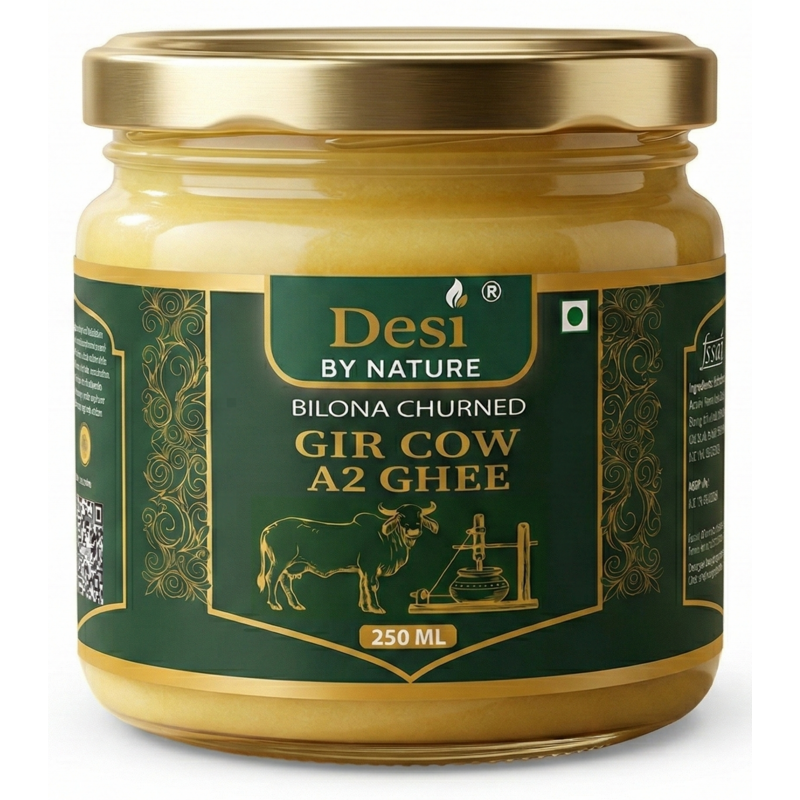
A2 is the most used term in Indian ghee marketing and one of the least explained. Here is what it actually refers to, and an honest account of how much it matters in ghee specifically.
The actual difference
Beta-casein is one of the main proteins in milk. It comes in several genetic variants, and the two that matter commercially are A1 and A2.
They differ at a single position in the protein chain. At amino acid position 67, the A2 variant has proline and the A1 variant has histidine. That one substitution changes how the protein breaks down during digestion. A1 beta-casein can release a peptide called beta-casomorphin-7 (BCM-7); A2 beta-casein does not release it in the same way.
The breeds
Indigenous Indian cattle, the humped Bos indicus breeds, predominantly carry the A2 variant. That includes Gir, Sahiwal, Tharparkar, Rathi and Red Sindhi.
The A1 variant appears more commonly in European Bos taurus breeds such as Holstein Friesian and Jersey, which were introduced widely across Indian dairying through the twentieth century for their higher milk yields. This is the real story behind the A2 revival: it is as much about which cattle India kept as about the protein itself.
On the health claims, honestly
You will find strong claims in both directions. The evidence is genuinely mixed. Some studies report differences in digestive comfort between A1 and A2 milk; a 2009 European Food Safety Authority review found the evidence insufficient to establish a causal relationship between BCM-7 and disease.
Our position is that the research is unsettled, and that anyone telling you it is definitively settled either way is ahead of the data. Many people report that A2 milk sits better with them. That is worth something, and it is not the same thing as proof.
Now, the part about ghee
This is where most brands go quiet, and where we would rather be straightforward with you.
Beta-casein is a protein. Ghee is almost entirely fat. In the process of making ghee, the milk solids, which is where the protein lives, are separated out and removed. That is what clarifying means. Under Indian standards, ghee must contain no more than 0.5% moisture, and what remains is effectively pure milk fat.
So the amount of beta-casein of any variant in a finished jar of ghee is negligible.
Which means an A2 label on ghee is not telling you about the protein you are eating. It is telling you about the source: that the milk came from indigenous A2-producing cattle rather than crossbred high-yield herds. That is a real and checkable statement about sourcing, breed and husbandry. It is not a statement about the protein content of the fat in the jar.
We think the sourcing claim is worth making, and worth paying for. We do not think it is honest to imply that a jar of ghee delivers the digestive benefits attributed to drinking A2 milk. Those are different products.
So what should you judge ghee on?
For ghee specifically, these matter more than the A2 label:
- Whether it was churned from curd or separated from cream. The bilona method ferments the milk into curd first, which changes both flavour and yield.
- What the milk was. Breed, feed and whether the herd grazes.
- Whether anything was added. Ghee has one ingredient.
- Whether it has been tested, and whether the brand will show you the result for your batch.
Our ghee is made from A2 Gir cow milk using the bilona method, under FSSAI licence 11525079000402. We buy A2 milk because of the animals and the dairying it implies, and we would rather tell you that plainly than let the label do work it cannot do. See the ghee.