Festival season is frying season. Puris for Ashtami, jalebis for Dussehra, shakarpara and mathri for Diwali. Sweet shops have fried in ghee for generations because it gives a clean, rich flavour and a crisp finish that oil cannot quite match. The hesitation at home is cost: filling a kadai with good ghee feels extravagant. Used carefully, though, frying ghee goes a lot further than people think.
How much ghee you actually need
Less than a full kadai. Use a small, deep kadai rather than a wide one, so the ghee is deep but the volume is small. For puris, about 2 to 3 inches of depth is enough for the puri to float and puff. In a small kadai, that is often 300 to 500 ml.
Fry in small batches. Two or three puris at a time keeps the temperature steady and lets you use less ghee.
The right temperature
Most Indian deep frying happens at roughly 170 to 190°C. Without a thermometer, test with a small piece of dough or batter:
- Sinks and stays down: too cold. Food will soak up ghee.
- Sinks, then rises steadily within a few seconds: right for most frying, such as pakoras and mathri.
- Rises immediately and sizzles hard: hot, right for puris that need to puff fast.
- Smokes: too hot. Turn off the heat and let it cool a little.
Temperature is the single biggest factor in how much ghee your food absorbs. Hot fat seals the surface quickly. Lukewarm fat soaks in.
Why ghee fries well
Ghee has had its milk solids removed, so it tolerates frying temperatures comfortably and does not scorch the way butter would. It is also relatively resistant to breaking down during repeated heating, compared with oils high in polyunsaturated fat. We covered the details in what the smoke point of ghee means.
Straining and storing used ghee
- Let it cool until warm, not hot, so you can handle it safely.
- Strain through a fine steel strainer lined with muslin or a clean cotton cloth, to catch every particle of batter and flour. Food particles are what make frying fat go bad fastest.
- Store in a separate, clean, dry steel or glass container with a lid. Label it as frying ghee.
- Keep it somewhere cool and dark, and use it within a couple of weeks.
How many times can you reuse it?
There is no single number, because it depends on what you fried and how hot it got. As a practical guide:
- Ghee used for puris or plain sweets at moderate heat, properly strained, can usually be reused for frying a few more times.
- Ghee used for battered or spiced food, such as pakoras, breaks down faster and picks up flavours. Reuse it once or twice for similar savoury frying.
- Do not reuse ghee used for fish or anything with a strong smell for sweets.
Food safety authorities advise against reusing any cooking fat repeatedly, because degradation products build up with each heating. Stop reusing ghee when it:
- has turned noticeably dark,
- smokes at a lower temperature than before,
- foams excessively,
- smells sharp, bitter or stale,
- or has become thick and sticky.
A second life beyond frying
Strained frying ghee that is still in good condition can be used for sautéing, tempering savoury dishes or roasting vegetables over the next few days. It carries a little flavour from whatever was fried in it, which is often welcome in a sabzi.
Order your frying
If you are frying several things on the same day, go from mildest to strongest: sweets and plain puris first, then mathri and shakarpara, then pakoras and spiced namkeen last. The ghee stays clean for longer.
Budgeting for a festival
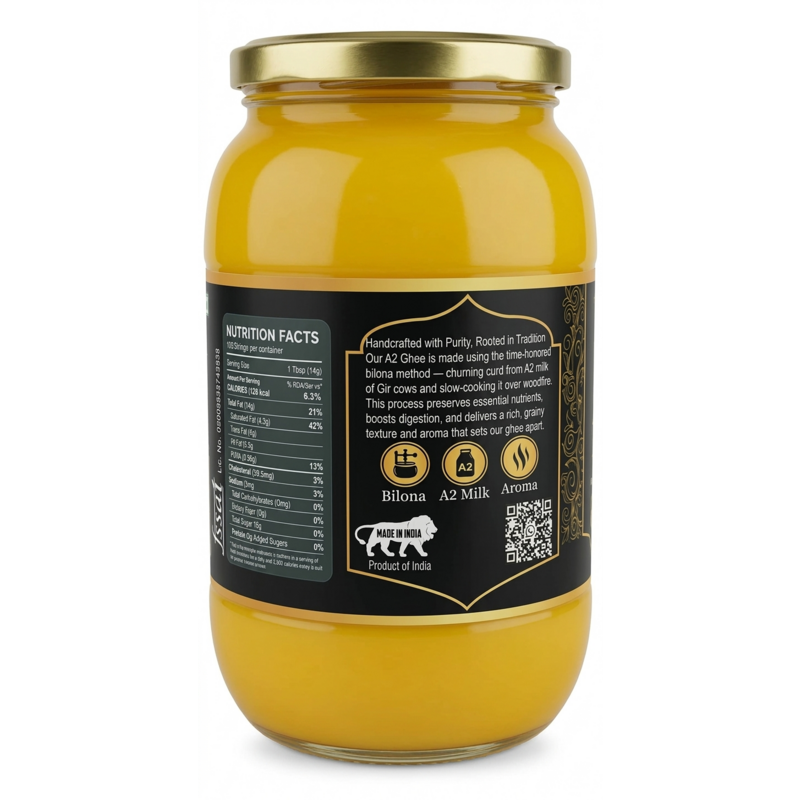
For a Diwali batch of sweets and snacks, many households fry with a portion of a 2.5 or 5 litre dolchi, and use the rest for sweets and daily cooking through the season. Our Desi Cow A2 Ghee is the more economical of our two ghees, and the 1 litre jar is the lowest price per ml; the dolchis suit you if you would rather keep one large stock for the season.