It is hard to talk about ghee in India without talking about Ayurveda. The classical texts give it an honoured place, and many families' habits around ghee, a spoon in warm milk, ghee with rice, ghee in a baby's food, come directly from that tradition. At the same time, a lot of online content presents traditional ideas as proven medical facts. We want to describe the tradition respectfully and honestly, without doing either of those things.
This piece describes traditional beliefs and practices. It is not medical advice, and nothing here replaces a qualified doctor or a registered Ayurvedic practitioner.
Ghee in the classical tradition
In Sanskrit, ghee is ghrita, and classical Ayurvedic writing describes cow ghee as among the most valued foods. It is generally described as nourishing and, in the tradition's own terms, as balancing for certain constitutions when used appropriately. We explored its place in wider Indian history in a short history of ghee in India.
Ghee as a carrier
One of ghee's most distinctive roles in Ayurveda is as a carrier. The tradition describes ghee as able to take on the properties of herbs and substances mixed with it and carry them into the body. It is sometimes described as yogavahi, a carrier or catalyst.
There is a straightforward modern parallel for part of this idea. Many plant compounds, including curcumin from turmeric and the flavour compounds in many spices, dissolve in fat rather than water, and fat-soluble compounds are generally better absorbed when eaten with some fat. That is one reason a tadka works so well in cooking: fat carries flavour. Whether that explains everything traditional texts claim for ghee as a carrier is a different, and much more open, question.
Medicated ghees (ghrita)
Ayurveda includes a class of preparations where herbs are cooked in ghee, sometimes with milk and herbal decoctions, to produce a medicated ghee. Different ghritas are prescribed in the tradition for different purposes. These are specific formulations prepared under traditional methods, and they are meant to be used under the guidance of a practitioner, not improvised at home.
Everyday traditional uses
- Ghee with food: a spoon on rice, dal or roti is considered to make food more nourishing and easier to digest in the tradition.
- Ghee in warm milk: commonly taken at night in some families.
- Old ghee: some traditional texts describe aged ghee as having particular uses. Please do not keep ghee for years at home on the strength of this; ghee in an ordinary kitchen goes rancid.
- External use: ghee applied to skin, lips and feet. We looked at this in ghee for dry winter skin.
- Nasal and eye practices: some traditional practices involve ghee in the nose or eyes. We would strongly advise against doing these without qualified guidance.
How to think about the evidence
Traditional knowledge built over centuries is valuable. It captures a great deal of practical experience about food, cooking and daily life. It is also true that traditional claims were not tested the way modern medicine tests treatments, and many specific health claims made for ghee online have not been demonstrated in good-quality studies.
A few sensible principles:
- Enjoy ghee as a traditional, flavourful food, in reasonable amounts.
- Be sceptical of any claim that ghee treats, reverses or prevents a specific disease.
- Do not replace prescribed medicine with ghee or home remedies.
- If you want Ayurvedic treatment, see a registered practitioner, and tell your doctor about it.
- Remember that ghee is a saturated fat with the same calories as any ghee, and if you have heart disease, high cholesterol or diabetes, your doctor should guide how much you eat.
Why cow ghee specifically?
Classical texts generally prefer cow ghee over ghee from other animals, and many families follow that preference, particularly for children, elders and ritual use. It is part of why indigenous cow ghee is so valued in India today.
Choosing ghee with tradition in mind
If you follow traditional practice, you will want ghee that is as close as possible to what the texts describe: pure cow ghee, made from cultured curd, with nothing added. That means checking the label, the method and, ideally, a batch lab report.
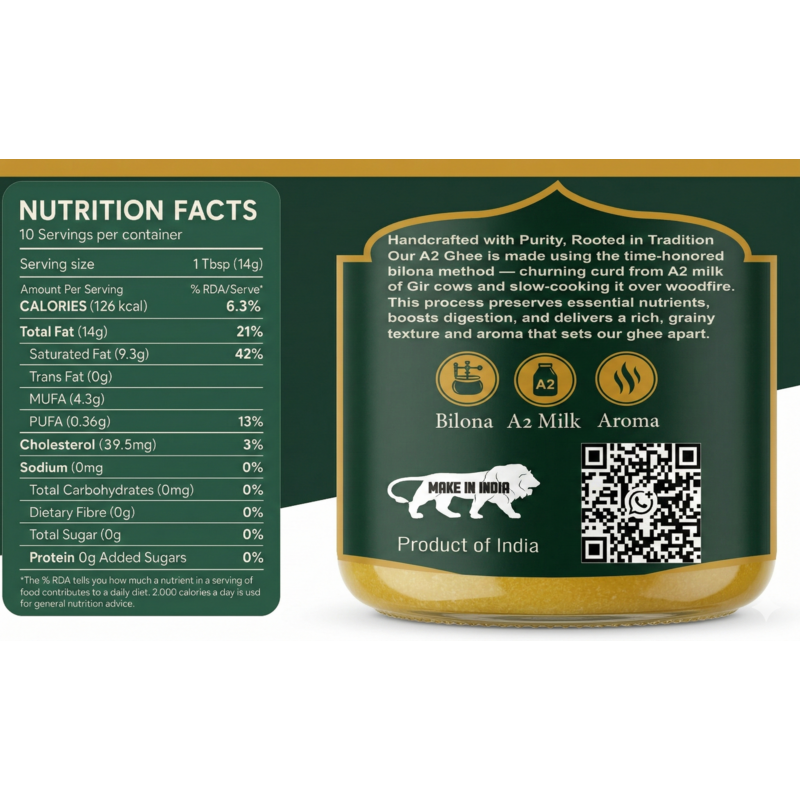
Our A2 Gir Cow Ghee is made from Gir cow milk by the bilona method. We sell it as a food, and describe it as one.