Few foods are as tied to Indian life as ghee. It is in the oldest texts, in daily rituals, in the kitchens of emperors and villages, in medicine and in memories of grandmothers' cooking. Its history is long and not always tidy, but a few chapters stand out.
Ghee in the ancient texts
Ghee appears in the Rig Veda, one of the oldest surviving texts in any Indo-European language, where the word ghrita is used and ghee is described as an offering poured into the sacred fire. The practice of offering ghee to fire, in yajna and later in havan, has continued in some form for thousands of years.
Cattle were central to the economy of early Indian societies, and milk products, including ghee, held great value. Ghee's special status likely owed something to practicality too: in a hot climate before refrigeration, clarifying butter was a way to preserve milk fat for months.
Ghee in epic and devotional tradition
Dairy runs all through Indian storytelling. The childhood of Krishna, the butter thief of Gokul, is full of stolen makkhan and pots of curd hung out of reach. Ghee lamps, ghee offerings and ghee-rich prasad became part of temple worship across the subcontinent. Many temple kitchens in South India are still famous for prasad made with large quantities of ghee.
Ghee in Ayurveda
Classical Ayurvedic texts describe ghee as a valued food and as a base for preparations, since fat-soluble herbs and compounds could be carried in it. Medicated ghees, known as ghritas, have a long traditional use. How those traditional uses relate to modern evidence is a separate question, and we have a piece on that later this month. As a historical fact, ghee's importance in traditional Indian medicine is clear.
Ghee at royal tables
Accounts of medieval and Mughal courts describe lavish cooking with ghee. Rich biryanis, kormas, sweets and breads were cooked in it, and the quantities recorded in some descriptions of royal kitchens are extraordinary. Regional kingdoms from Rajasthan to the Deccan had their own ghee-heavy traditions, many of which survive in dishes such as dal baati churma, Mysore pak and Hyderabadi sweets.
Ghee in everyday village life
For most people, though, ghee was not a luxury in the way it was at court. In villages where families kept a cow or buffalo, milk was set into curd, churned into butter and cooked into ghee as a routine part of the household economy. The buttermilk was drunk; the ghee was stored and sometimes sold or traded. This household bilona method, described in how bilona ghee is made, is essentially how ghee was made across India for most of its history.
The arrival of vanaspati
In the 1930s, hydrogenated vegetable fat, vanaspati, began to be manufactured and sold in India. It was cheaper than ghee, kept well, and could be made to look and behave somewhat like it. It was marketed heavily and became a household staple, especially in cities and in commercial cooking, for decades.
Vanaspati also became one of the most common ghee adulterants, which is part of why testing for vegetable fats remains central to ghee standards today. We explain one of those tests in the Baudouin test.
Operation Flood and the dairy revolution
From 1970, the government-backed programme known as Operation Flood transformed Indian dairying, linking village milk producers through cooperatives to urban markets. India's milk production grew enormously, and over the following decades it became the largest milk producer in the world. Ghee became a mass-market packaged product, and large dairy brands took over much of its production using modern cream-separation methods.
The retreat, and the return
In the 1980s and 1990s, health messaging around saturated fat and heavy marketing of refined oils led many urban families to cut back on ghee, or give it up. For a generation, ghee became something for festivals and special occasions.
Since around the 2010s, the pendulum has swung back. Renewed interest in traditional foods, a more nuanced public conversation about fats, and the rise of small producers selling bilona and A2 ghee directly have brought ghee back into daily use in many homes. We looked at that shift in ghee vs refined oil.
What has not changed
Through all of it, the basic process is the same as it was in a Vedic village: milk, curd, butter, fire, and patience. The best ghee is still judged by the same test a grandmother would use, the smell when it is warmed.
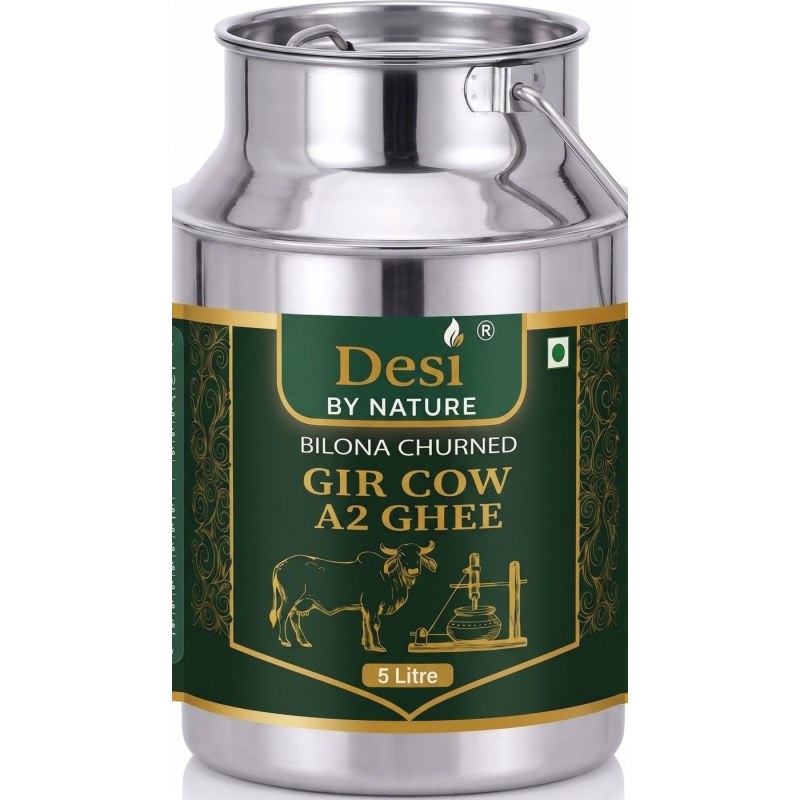
Our A2 Gir Cow Ghee and Desi Cow A2 Ghee are made by that traditional bilona method.