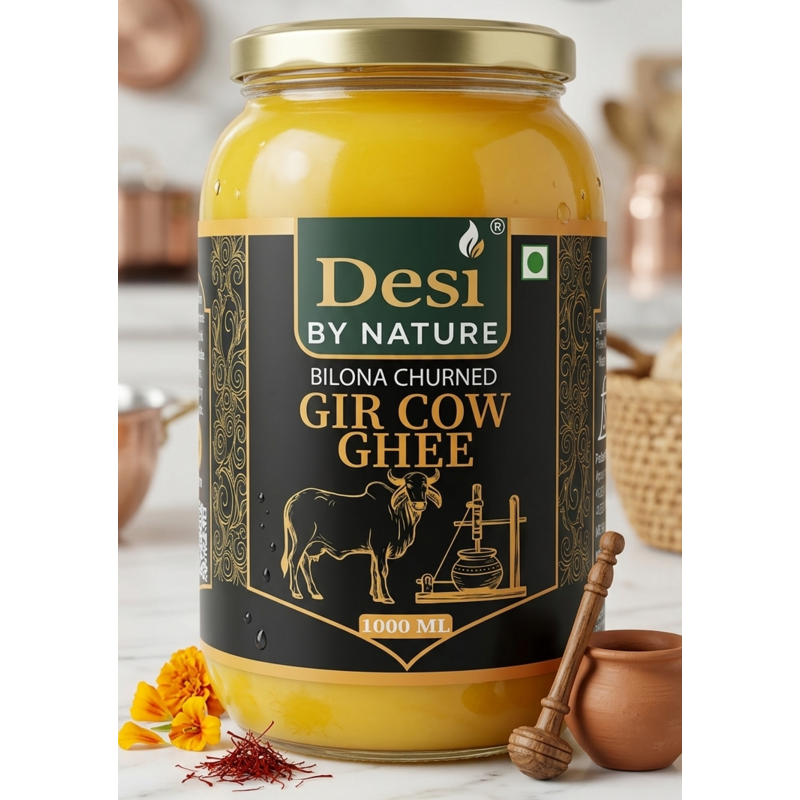
In a lot of Indian homes, ghee is not bought at all. Every day, the malai that forms on boiled milk is skimmed into a steel box in the fridge. Once the box is full, it is churned into butter and cooked into ghee. It is a lovely tradition, and it is the reason many people are baffled when they see what a jar of bilona ghee costs in a shop.
So is homemade ghee cheaper? It depends on what you count. Here is an honest attempt.
Method 1: Ghee from collected malai
This is the most common homemade method. You buy full-cream milk for drinking, tea and curd anyway. The malai is a by-product.
What it costs: In money, very little extra, because you were buying the milk regardless. The real costs are:
- Fat you did not drink. Skimming malai means your family drinks slightly lower-fat milk. Some families prefer that; either way, the fat was paid for.
- Time. Collecting for one to three weeks, then churning or whisking, washing the butter and slowly cooking it takes a couple of hours of attention.
- Fridge space and gas. Small, but real.
What it yields: Less than people expect. A family using a litre or so of full-cream milk a day may end up with perhaps a small bowl of ghee after a couple of weeks, depending on the milk. Many families find homemade ghee covers part of their use, not all of it.
What kind of ghee it is: This matters. Malai ghee is cream-based. If you set the malai with a spoon of curd before churning, as many families do, it becomes a cultured cream ghee, closer in flavour to bilona. If you simply heat the malai or churn it fresh, it is cream ghee. Either way, it is usually made from packet milk from crossbred or mixed herds, not A2 milk from indigenous cows. That is not a problem, but it is a different product from bilona A2 ghee.
Verdict: If you already buy full-cream milk and enjoy the ritual, malai ghee is excellent value and tastes wonderful. It is not really "free", but it is close.
Method 2: Bilona ghee from whole milk at home
Some people want to make traditional bilona ghee: set whole milk into curd, churn all of it, collect the butter and cook it.
What it costs: This is where the numbers get serious. A litre of bilona ghee needs roughly 25 to 30 litres of milk, as we worked through in how much milk goes into bilona ghee. If you buy that milk at retail prices, the milk alone will usually cost more than a litre of good bilona ghee from a shop. Add indigenous A2 milk, which is harder to find and more expensive than packet milk, and the gap widens.
Why can a dairy sell for less than your retail milk bill? Because dairies do not pay retail prices for milk, they do not pay for packaging on every litre, and they process at a scale where the time per litre is small.
Time and equipment: Setting 25 litres of curd, churning it and cooking the butter is a full day's work and needs large vessels and plenty of fridge space.
What you get: About a litre of ghee and 20-something litres of buttermilk, which is more chaas than most families can drink before it turns sour.
Verdict: Satisfying as a one-off project. Not economical as a regular habit for most urban families.
The costs people forget
- Failed batches. Burnt ghee or ghee with moisture left in it happens to everyone occasionally.
- Consistency. Homemade batches vary a lot.
- Verification. You know exactly what went into homemade ghee, which is a real advantage. You do not know the quality of the milk in the same way a lab test would show for a bought batch.
So which makes sense?
Make it at home if: you already buy full-cream milk, enjoy the process, and are happy with cream-based ghee made from ordinary milk.
Buy it if: you specifically want bilona ghee from indigenous A2 milk, you use more ghee than your malai produces, or you do not have the time.
Do both if: you like homemade ghee for everyday cooking and want a jar of bilona ghee for the table, for festivals or for gifting. Many of our customers do exactly this.
If you are buying, our Desi Cow A2 Ghee is bilona ghee from indigenous cow milk at a price well below what the milk would cost you at home.