If you ask ten traditional ghee makers how much milk they need for a litre of ghee, you will probably get ten different answers, most of them somewhere between 25 and 35 litres. They are not being vague. The number genuinely moves, and the reasons it moves are a good way to understand what you are paying for.
The theoretical floor
Ghee is about 99.5 percent fat. A litre of it weighs roughly 910 grams. So a litre of ghee is about 905 grams of milk fat.
If milk contains 4 percent fat, each litre holds about 40 grams of it (strictly, a litre of milk weighs a little over a kilo, but the difference is small enough to ignore here). To collect 905 grams of fat you would need about 23 litres of milk, if you could recover every last gram. No process can, so the real number is always higher.
What changes the number
1. The fat content of the milk. This is the biggest factor. Indigenous cow milk typically ranges from around 3.5 to 5 percent fat. At 3.5 percent, the theoretical floor rises to about 26 litres before any losses. At 5 percent, it falls to about 18.
2. The breed. Different breeds give milk of different richness. Among Indian breeds, Gir and Sahiwal milk is often in the richer part of the range, though individual animals vary a great deal.
3. The season and feed. Milk fat rises and falls through the year. Green fodder after the monsoon, dry fodder in summer, heat stress and water intake all change it. A dairy may need noticeably more milk for the same ghee in May than in December.
4. Stage of lactation. Milk from late in a cow's lactation is usually richer than milk from the weeks just after calving, when volumes are high.
5. The method. This is where bilona and cream separation part ways. A mechanical separator removes fat from milk with high efficiency. Churning curd is far less efficient, and a meaningful share of the fat stays behind in the buttermilk. That alone can push the bilona figure several litres above the cream method.
6. The maker. Churning temperature, how long the churn runs, how carefully the butter is gathered, and how much is lost in washing and cooking all add up. An experienced maker loses less.
A worked example
Say the milk has 4 percent fat, and the bilona process recovers about 80 percent of it as butter fat that ends up in the jar.
- Fat per litre of milk: about 40 g
- Recovered per litre: about 32 g
- Fat needed for a litre of ghee: about 905 g
- Milk required: 905 ÷ 32 = about 28 litres
Drop the fat content to 3.6 percent and keep recovery the same, and you need about 31 litres. Push recovery down to 70 percent and it climbs to around 36.
These are illustrative numbers, not measurements from any particular dairy. The point is how sensitive the result is to small changes.
And by weight?
People sometimes quote a figure per kilogram of ghee rather than per litre. Since a litre of ghee weighs a little less than a kilo, the per-kilo figure is roughly 10 percent higher. Worth knowing when you compare claims.
Why this matters to a buyer
Because it puts a floor under the price. Once you know a litre of bilona ghee needs something like 25 to 30 litres of indigenous cow milk, you can do a rough sum with local milk prices and see whether a jar is plausibly priced. We did exactly that sum in why bilona ghee costs more.
It also explains why bilona ghee is so hard to scale honestly. Every extra litre sold needs another cowshed's worth of milk, not just a larger machine.
A note on claims you may see
Occasionally a brand advertises a strikingly precise or unusually high figure, such as 40 litres or more. It is possible with thin milk or an inefficient process, but it is not a boast. Using more milk than necessary is not a quality signal in itself. What matters is that the method is genuine and the ghee is good.
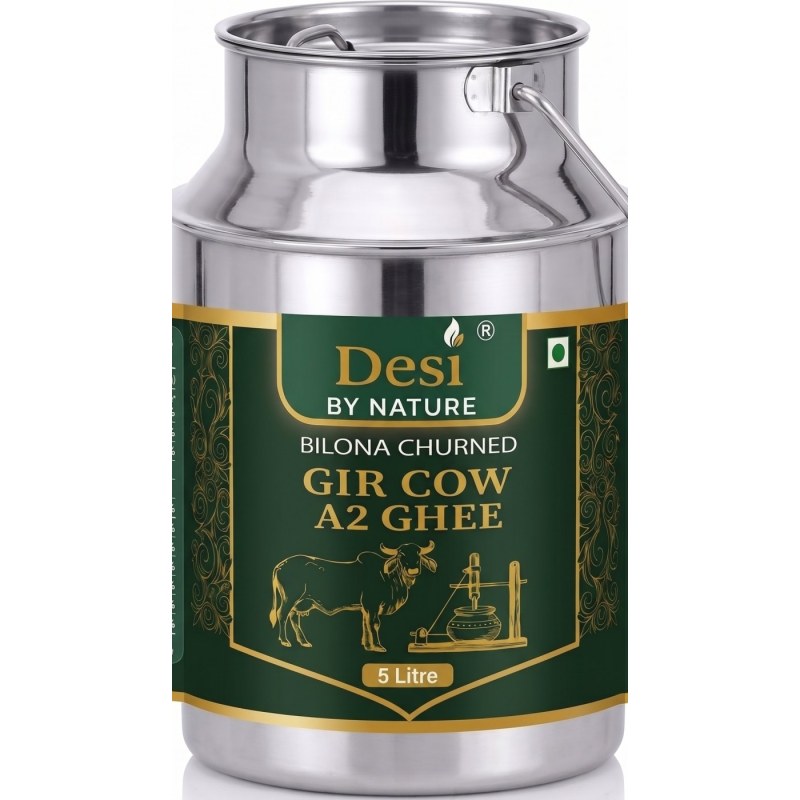
Both our A2 Gir Cow Ghee and Desi Cow A2 Ghee are made by the curd-churned bilona method, which is exactly why they sit where they do on price.