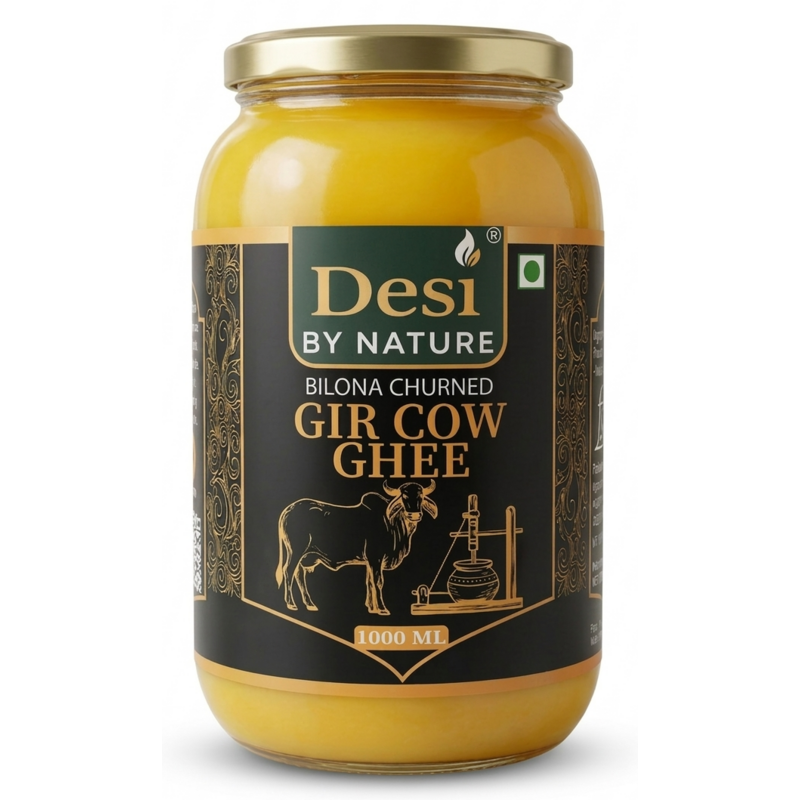
"Why is your ghee so expensive?" is a fair question, and we get it often. A litre of well-known supermarket ghee might cost a fraction of what a litre of bilona ghee does. It is natural to suspect that the difference is mostly packaging and a nice story.
It is not. Most of it is milk. Here is the arithmetic, as plainly as we can put it.
Start with the fat in the milk
Ghee is almost entirely milk fat. Indigenous cow milk typically contains somewhere around 3.5 to 4.5 percent fat. A litre of ghee weighs roughly 910 grams.
At 4 percent fat, a litre of milk contains about 40 grams of fat. If you could recover every gram of it, you would need around 23 litres of milk to make a litre of ghee. That is the theoretical minimum, and nobody achieves it.
Then account for how the fat is recovered
This is where methods diverge.
Cream separation, used for most commercial ghee, spins milk in a centrifuge and pulls out the fat very efficiently. Relatively little fat is left behind in the skimmed milk, and that skimmed milk is itself sold, which offsets the cost further.
Bilona sets the whole milk into curd and churns the curd. Churning is much less efficient. A meaningful share of the fat stays in the buttermilk. There are more losses when the butter is washed and cooked. The result is that bilona ghee commonly needs something in the range of 25 to 30 litres of milk per litre, and sometimes more, depending on the fat content of the milk and the skill of the maker. We explained the process in detail in how bilona ghee is made.
Now put a price on that milk
Milk from indigenous breeds generally costs more than ordinary dairy milk, because these cows produce smaller quantities than high-yield crossbreds. Gir milk in particular sells at a premium. Even at modest prices per litre, 25 to 30 litres adds up quickly, and the milk cost alone can come to a large share of what you pay for a litre of bilona ghee.
Yes, the buttermilk has some value. In a village it is drunk or given away. Commercially, it is worth very little compared with the milk that went in.
Then add time
Curd takes hours to set, usually overnight. Churning and slow cooking take more hours. A traditional dairy cannot run the process around the clock at industrial volumes. Less output per worker, per day, per vessel means higher cost per litre.
Then testing and packaging
Glass jars cost several times more than plastic tubs, weigh more to ship and break more often. Independent laboratory testing of every batch has a fee attached. Neither of these is a large share of the price, but both are real, and both are choices a cheaper brand can skip.
So what does a fair price look like?
We are wary of quoting a number that will date quickly, but the logic is durable. If a product calls itself bilona or A2 and is priced close to ordinary cream ghee, ask how. Either the milk is not what it claims to be, the process is not what it claims to be, or the business is selling at a loss. None of these is a good sign.
The reverse does not hold. A high price is easy to put on any jar. Price is useful as a floor, not as proof.
Is it worth it?
That depends on how you use ghee. If it is mostly a cooking fat in heavily spiced food, a cheaper ghee may serve you perfectly well. If you eat it as it is, on rice or roti, or cook the kind of simple food where its flavour carries the dish, the difference is easy to taste. A lot of families split the difference: a good jar for the table, a larger, more economical one for the stove.
Buying a sensible size helps too. Per ml, a 1 litre jar costs noticeably less than a small one, and ghee keeps for months when it is stored well.
Our A2 Gir Cow Ghee is at the premium end because the milk is. Our Desi Cow A2 Ghee is made the same way from indigenous cow milk and costs less. Both are priced on the arithmetic above.