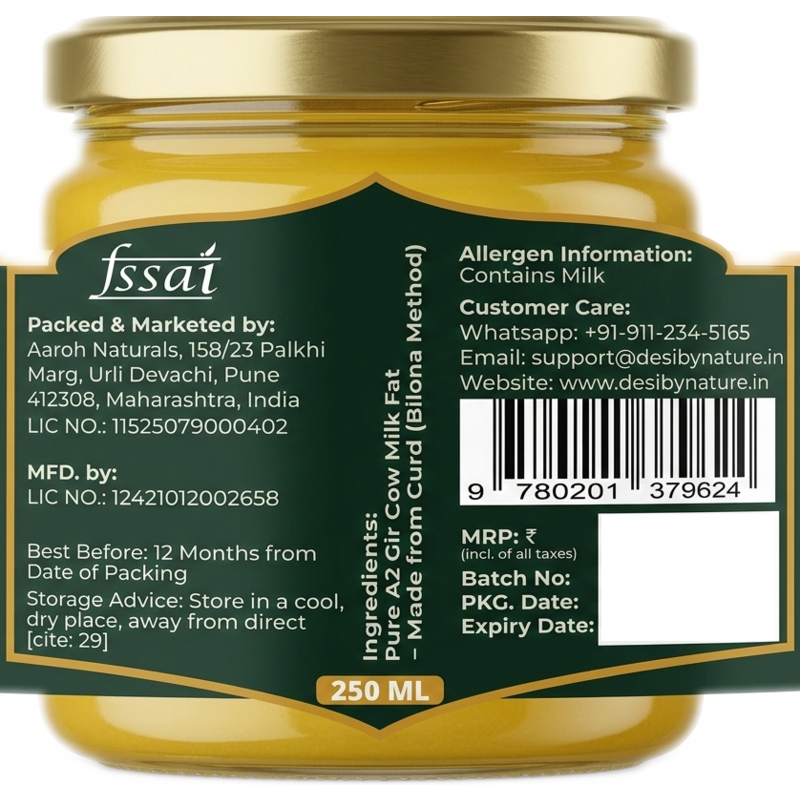
A decade ago, almost nobody in India had heard of A2 milk. Now the letters appear on milk pouches, paneer, curd and a great many jars of ghee. The science behind the label is actually fairly simple. The marketing around it is where things get muddled.
Milk is mostly water, fat, sugar and protein
Cow's milk is roughly 87 percent water. The rest is lactose (milk sugar), fat, minerals and protein. Of the protein, about four-fifths is a family called caseins, and the rest are whey proteins.
Caseins are what make milk white and what clump together when you make paneer or curd. There are several types. One of the largest is beta-casein, which makes up around a third of the casein in cow's milk.
A1 and A2 are two versions of beta-casein
Beta-casein is a chain of 209 amino acids. In one version, the amino acid at position 67 is proline. That version is called A2. In another, the same position holds histidine. That one is called A1.
One amino acid out of 209 does not sound like much. It matters because of how the protein breaks down during digestion. When A1 beta-casein is digested, it can release a small peptide called beta-casomorphin-7, or BCM-7. A2 beta-casein releases much less of it. That difference is the entire basis of the A2 discussion.
Where the two versions come from
The original form of beta-casein in cattle was A2. The A1 variant is believed to have arisen through a mutation in European cattle several thousand years ago and spread through breeds such as Holstein-Friesian, which now dominate commercial dairying worldwide.
Indigenous Indian breeds, known as zebu or Bos indicus cattle, such as Gir, Sahiwal, Red Sindhi and Tharparkar, carry predominantly the A2 gene. Crossbred cows with European ancestry often produce a mix. Buffalo milk also contains beta-casein of the A2 type.
Whether a particular cow gives A2 milk is a matter of her genes, and it can be tested. Breed is a strong indicator but not a perfect one.
What the research says about A1 and A2
Here we want to be careful, because this is where a lot of labels overreach.
Some studies have found that people who report discomfort after drinking regular milk have fewer digestive symptoms on milk containing only A2 beta-casein. That research is interesting and continuing. Claims linking A1 milk to serious diseases, however, are not established, and major food safety bodies have not concluded that A1 milk is harmful. Anyone who tells you otherwise is ahead of the evidence.
And what it means for ghee
This is the part most A2 ghee labels do not explain. Ghee is almost pure fat. During clarification, nearly all the milk proteins, including beta-casein, are removed as the solids brown and are strained out. The nutrition panel on a jar of ghee shows 0 g protein for good reason.
So "A2 ghee" is a statement about the milk the ghee came from, and by extension about the cows: indigenous breeds rather than European or crossbred herds. It is not a claim that you are eating meaningful amounts of A2 protein. We covered this at more length in A2 vs A1 milk and what it means for ghee.
Why people still choose A2 ghee
For reasons that have little to do with the protein itself. Choosing A2 ghee usually means choosing ghee from indigenous cattle, often from smaller dairies, and very often made by traditional methods such as bilona. For many buyers that is about flavour, tradition and supporting native breeds, and those are perfectly good reasons.
What we would caution against is paying extra because a label implies A2 ghee delivers health benefits that come from A2 milk protein. The protein is not really there.
Three things to remember
- A1 and A2 are two versions of one milk protein, beta-casein, differing by a single amino acid.
- Indigenous Indian cattle mostly produce the A2 version.
- Ghee contains almost no protein, so "A2" on ghee describes its source, not its contents.
Both of our ghees, the A2 Gir Cow Ghee and the Desi Cow A2 Ghee, are made from indigenous cow milk, and we try to describe them in exactly those terms.