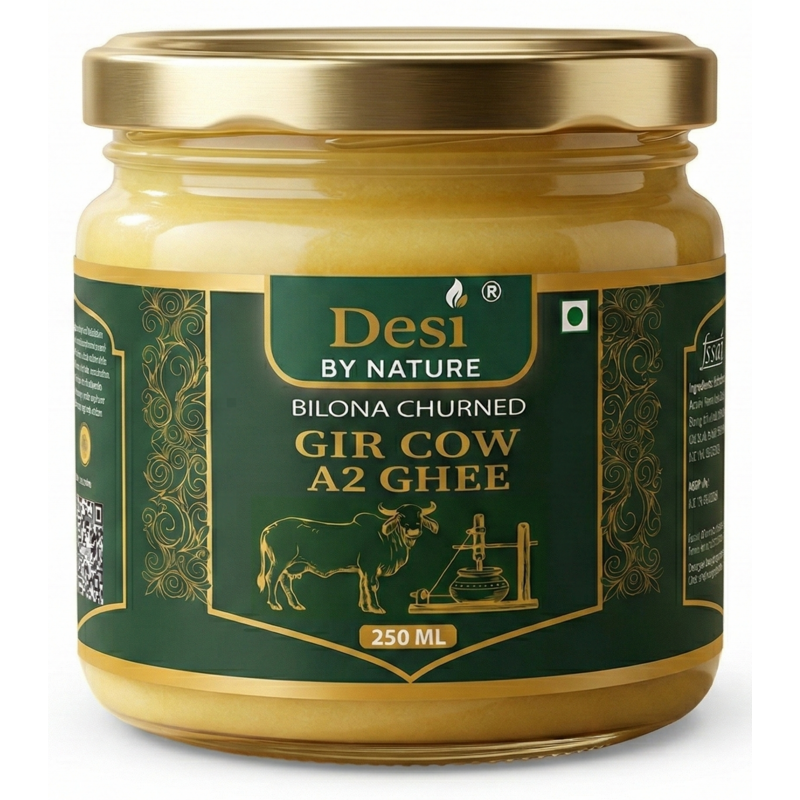
One of the messages we get most often goes something like this: "My new jar is a different colour from the last one. Is something wrong?" Usually the answer is no. Ghee made from real milk changes through the year, in colour, texture and even aroma. The uniformity of some commercial ghee is the unusual thing, not the variation.
Colour comes from what the cows eat
The yellow in cow ghee comes mainly from beta-carotene, a natural pigment found in green plants. Cows eat it in fresh grass and green fodder, and some of it passes into the fat in their milk. Ghee concentrates that fat, and the colour with it.
So the colour follows the fodder calendar:
- After the monsoon and into winter, when green fodder is plentiful, ghee is often a deeper golden yellow.
- In late summer, when animals eat more dry fodder, straw and stored feed, ghee tends to be paler.
Breed plays a part too. Some indigenous breeds give noticeably more golden milk fat. Buffalo milk is a different case altogether: buffaloes convert beta-carotene into colourless vitamin A more efficiently, which is why buffalo ghee is white.
Texture comes from the weather
Ghee is a mixture of fats that melt at different temperatures. Some are liquid at room temperature and some are solid.
- On hot days, above roughly 30°C, most ghee is fully or mostly liquid.
- On mild days, it sits somewhere in between, soft and spoonable.
- In cooler months, it sets firmer, often with a grainy, danedar texture.
The same jar can move between all three states if it travels from a warm warehouse to a cool home. The fat profile also shifts slightly with the season's feed, which changes how the ghee sets. We explain the grainy texture in detail in why ghee turns grainy.
Aroma shifts a little too
Bilona ghee depends on curd, and curd sets differently in summer and winter. Warm weather speeds fermentation and can give a slightly tangier note. Cool weather slows it. Skilled makers adjust for this, but some natural variation remains, and we think that is part of its character.
What is normal
- A jar that is paler or deeper yellow than your last one.
- Ghee that is liquid in summer and solid in winter.
- A grainy set in one batch and a smoother set in another.
- A thin liquid layer on top with solid ghee below, which happens when a jar partly melts and resets.
- A slightly different aroma intensity between batches.
What is not normal
- A sour, cheesy or rancid smell. Good ghee smells nutty. Rancid ghee smells sharp and unpleasant, sometimes like old paint.
- Mould or visible spots. Almost always caused by water or food getting into the jar through a wet spoon.
- Separation into distinct layers that do not remix when warmed, or a waxy, oily feel. Worth asking the seller about.
- A colour that is unnaturally bright or orange, and never changes at all from batch to batch.
Why perfectly uniform ghee is not a better sign
Large brands blend milk fat from many sources and seasons, and standardise processing, so every tub looks alike. That is a legitimate industrial choice. It is not evidence of higher quality, and it is not how ghee from small dairies behaves. If anything, a small maker's ghee that looked identical in July and January would make us curious.
Both our A2 Gir Cow Ghee and Desi Cow A2 Ghee change with the seasons in exactly these ways. If a jar ever smells wrong to you, send us the batch number on WhatsApp and we will look into it.