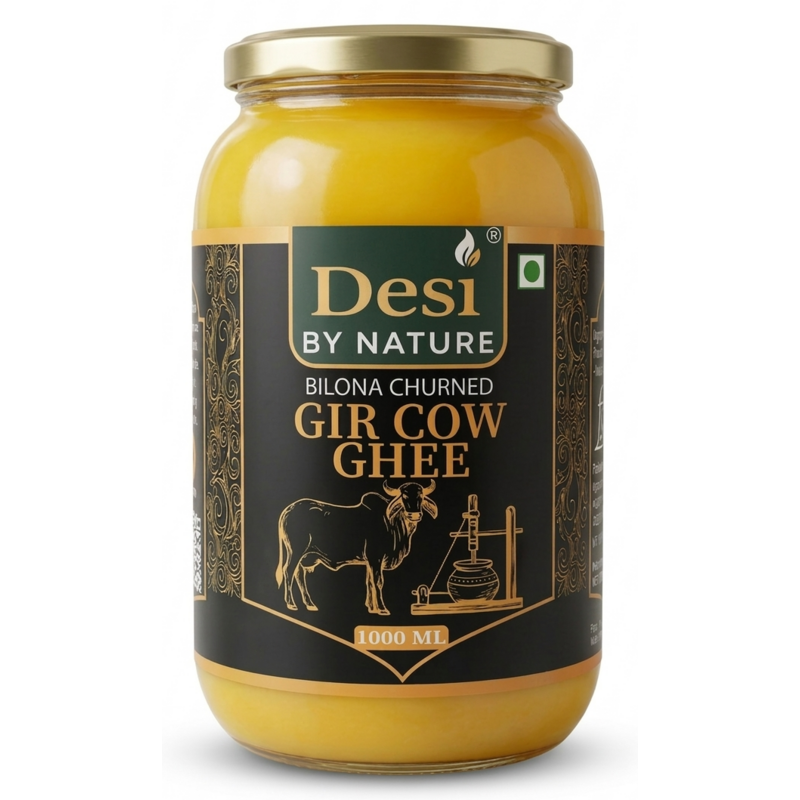
People often ask how long a litre of ghee lasts. The honest answer is that it depends entirely on what you cook. So here is a realistic week for a family of four eating home-cooked North and West Indian food, with the ghee measured. It is a plan, not a prescription, and your family's meals will look different, but it gives a useful sense of scale.
A few measurements first
- 1 teaspoon of ghee is about 5 ml.
- 1 tablespoon is about 15 ml.
- A litre is roughly 200 teaspoons, or 65 tablespoons.
Monday
Breakfast: Poha with a ghee tempering (2 tsp).
Lunch: Dal tadka and rice (tadka 2 tbsp = 6 tsp), 8 phulkas brushed with ghee (2 tsp).
Dinner: Mixed vegetable sabzi (1 tbsp = 3 tsp), rotis (2 tsp).
Total: about 15 tsp.
Tuesday
Breakfast: Aloo parathas for four (6 tsp).
Lunch: Rajma and jeera rice (rice 2 tbsp = 6 tsp; rajma 1 tbsp = 3 tsp).
Dinner: Moong dal khichdi with a spoon of ghee each (4 tsp in cooking, 4 tsp on top).
Total: about 23 tsp.
Wednesday
Breakfast: Upma (2 tbsp = 6 tsp).
Lunch: Chole and rotis (chole 1 tbsp = 3 tsp; rotis 2 tsp).
Dinner: Egg bhurji or paneer bhurji and toast (1 tbsp = 3 tsp).
Total: about 14 tsp.
Thursday
Breakfast: Besan chilla (3 tsp).
Lunch: Kadhi and rice with a ghee tadka (5 tsp).
Dinner: Palak paneer and rotis (palak 1 tbsp = 3 tsp; rotis 2 tsp).
Total: about 13 tsp.
Friday
Breakfast: Ghee toast with a sprinkle of sugar for the children, eggs or fruit for adults (3 tsp).
Lunch: Dal, sabzi, rice and rotis (tadka 5 tsp; rotis 2 tsp; sabzi 3 tsp).
Dinner: Vegetable pulao and raita (2 tbsp = 6 tsp).
Total: about 19 tsp.
Saturday
Breakfast: Dosa with a little ghee on each (6 tsp).
Lunch: Pav bhaji, cooked and served with ghee instead of butter (2 tbsp in the bhaji, 4 tsp on pav = 10 tsp).
Dinner: Light khichdi or leftover pulao (4 tsp).
Total: about 20 tsp.
Sunday
Breakfast: Puri bhaji, puris fried in a small kadai of ghee (about 150 ml absorbed and lost, the rest strained and kept) plus bhaji (3 tsp). Count about 30 tsp.
Lunch: Paneer butter masala, jeera rice and rotis (about 10 tsp).
Dessert: Sooji halwa (4 tbsp = 12 tsp).
Dinner: Soup and toast (2 tsp).
Total: about 54 tsp.
The week in total
Adding it up comes to roughly 160 teaspoons, or around 800 ml. With a Sunday puri breakfast and halwa, a family like this goes through close to a litre of ghee a week. Without the fried breakfast and the sweet, it is closer to 600 ml.
That is a lot more than many people guess, and it explains why regular ghee buyers so often move from 500 ml jars to 1 litre jars or dolchis.
Ways to make a litre last longer
- Use ghee where you taste it: tadka, rotis, rice, sweets. Use a neutral or regional oil for frying and heavily spiced gravies.
- Brush, do not pour, on rotis and parathas. A pastry brush uses half as much.
- Strain and reuse frying ghee once or twice. See deep frying in ghee without waste.
- Choose a flavourful ghee. A bilona ghee with real aroma gives more flavour from less.
And a note on balance
Spread across four people and seven days, 600 to 800 ml works out to somewhere between 4 and 6 teaspoons of ghee per person per day in this plan, before any other oils. If you are watching fat intake, that is worth knowing, and it is easy to adjust by using ghee in some meals and not others.
For a family cooking like this, the 1 litre jar or 2.5 litre dolchi of Desi Cow A2 Ghee is usually the practical choice.