Ghee is delicious, and it is energy-dense. Both things are true, and it helps to know the numbers. This is not a diet plan. It is a clear explanation of what a spoon of ghee contains and how it fits into general guidance, so you can make your own decisions.
The basic numbers
Ghee is almost pure fat, and fat provides about 9 kcal per gram. So:
- 1 teaspoon (about 5 g): roughly 45 kcal
- 1 tablespoon (about 14 g): roughly 126 kcal
- 100 g: roughly 900 kcal
These figures are the same for any genuine ghee. A2 ghee, Gir ghee, bilona ghee and ordinary ghee all have the same calories per gram.
What is in a tablespoon
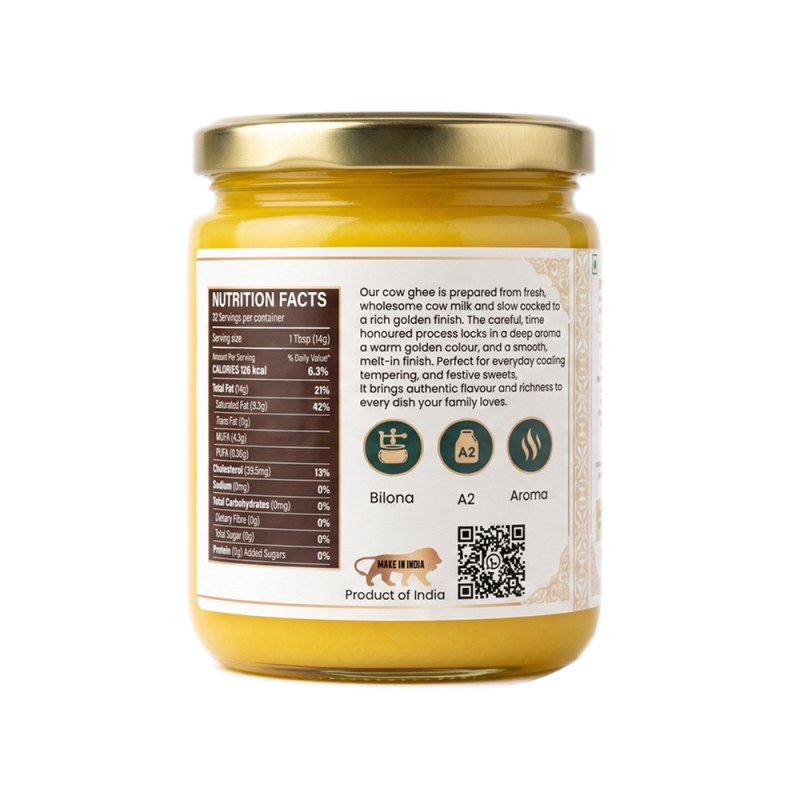
Here is what the label on our Desi Cow A2 Ghee shows per 14 g serving:
- Energy: 126 kcal
- Total fat: 14 g
- Saturated fat: 9.3 g
- Monounsaturated fat: 4.3 g
- Polyunsaturated fat: 0.36 g
- Trans fat: 0 g
- Cholesterol: 39.5 mg
- Carbohydrate, protein, sodium: 0
Values vary slightly between batches and brands, but this is typical for cow ghee. Ghee also contains small amounts of fat-soluble vitamins such as vitamin A, varying with the animals' feed.
How that fits general guidance
General dietary guidance, both in India and internationally, tends to make three broad points about fats:
- Fat is an essential part of a healthy diet, needed for energy and for absorbing fat-soluble vitamins.
- Total visible fat, meaning oils, ghee and butter added in cooking and at the table, should be moderate. Indian dietary guidance has suggested limits in the range of roughly 25 to 30 grams a day for many adults on a typical energy intake, adjusted for activity and individual needs.
- Saturated fat should be limited, with a common international guideline being less than about 10 percent of daily energy.
Put into kitchen terms, and using these general figures only as a rough guide: 25 to 30 grams of visible fat is about 2 tablespoons of all oils and ghee combined, in a day. For someone eating around 2,000 kcal, 10 percent of energy from saturated fat is about 22 grams, and a tablespoon of ghee supplies roughly 9 of those.
So for many adults, a tablespoon or so of ghee a day, as part of a mix of fats and a balanced diet, sits comfortably within general guidance. Your own needs may be different, especially if you are very active, pregnant, a growing child, or managing a health condition such as high cholesterol or heart disease. In those cases, a doctor or registered dietitian is the right person to advise you.
Where the calories actually add up
People often underestimate ghee because it is spread across many small uses. A tadka, a spoon on rice, a brush on each roti, a paratha and a small sweet can add up to several tablespoons without feeling like much. We counted a real week in a week of meals with a litre of ghee, and the result surprised us.
Practical ways to enjoy ghee sensibly
- Use it where you taste it. On rice, rotis, dal tadka and sweets, ghee's flavour is the point. In a heavily spiced curry, a small amount goes a long way, and oil works too.
- Measure for a week. Use a teaspoon rather than pouring from the jar. Most people are surprised.
- Brush rather than pour on rotis and parathas.
- Choose a flavourful ghee. A ghee with real aroma satisfies with less.
- Balance across the day. A ghee-rich lunch can be followed by a lighter dinner.
- Mix your fats. Use ghee for some things and a regional oil for others.
A word on claims
You will read online that ghee "burns fat" or helps weight loss. There is no good evidence that ghee has special properties that make its calories count for less. Nor is there reason to fear a sensible amount of it. Ghee is a traditional, flavourful food. Enjoy it as one.
The full nutrition label for our Desi Cow A2 Ghee is photographed on its product page.