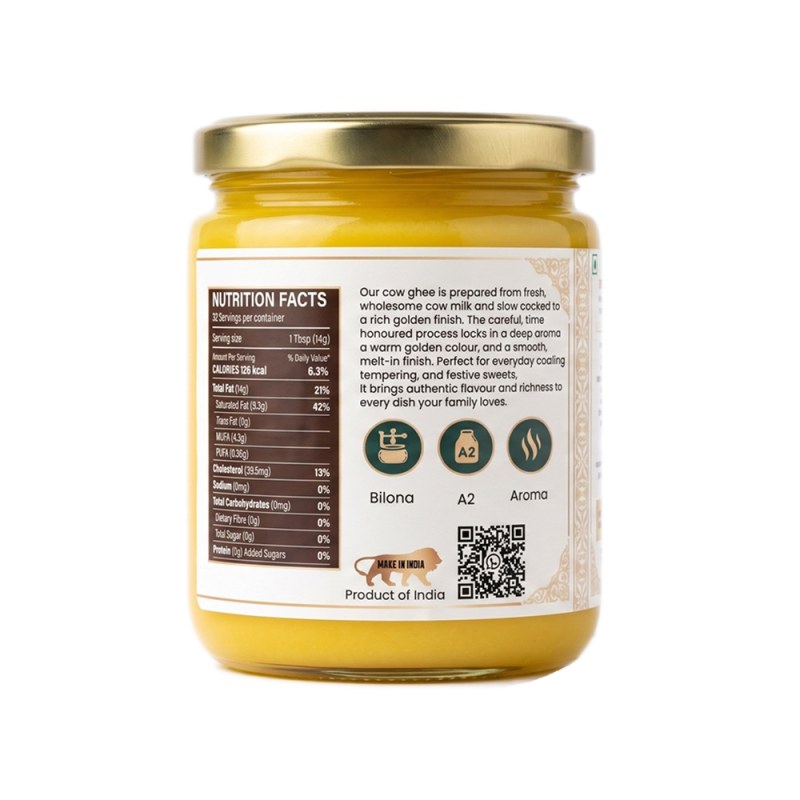
Most people choose ghee by the front of the jar: the brand, the picture of a cow, the word "pure". The more useful information is on the back and sides, and much of it is there because food law in India requires it. Here is how to read it, section by section.
The product name
Look for the word "ghee" itself, and what comes with it. "Cow ghee" should be made from cow milk. "Ghee" alone may be from cow, buffalo or mixed milk. Watch for names that avoid the word entirely, such as "desi danedar", "dairy spread" or "vanaspati". A product that is not ghee cannot legally be called ghee, so creative naming is a clue.
The ingredient list
For pure ghee, there should be one ingredient, typically "milk fat", "cow milk fat" or "ghee". Anything else, such as flavour, colour, vegetable fat or antioxidants, means you are not buying plain ghee.
The FSSAI logo and licence number
Packaged food in India must display the FSSAI logo with a 14-digit licence or registration number. This identifies the business legally responsible for the product. You can check the number on the FSSAI's public licence search to see which company it belongs to and whether the licence is current.
If a label shows more than one licence number, often one belongs to the manufacturer and another to the brand owner or packer. That is normal when a brand works with a separate producer.
The green dot
The green square with a green dot marks the food as vegetarian. Ghee should always carry it.
Name and address
The label must show who manufactured, packed or marketed the product, with an address. A clear, complete address is more reassuring than just a website or a city name.
Net quantity
Ghee is sold by volume (ml, litre) or by weight (g, kg). They are not the same: a litre of ghee weighs roughly 910 grams. So a "1 kg" pack contains more ghee than a "1 litre" pack. Compare like with like when looking at price.
MRP
The maximum retail price, inclusive of all taxes. Nobody can legally charge you more than this. Discounts below MRP are common, especially online.
Date of manufacture or packing, and best before
Both should be printed. Most ghee carries a best before date of around 9 to 12 months from packing. Given a choice, pick the freshest jar, because aroma is best early in a jar's life.
Batch or lot number
This identifies the production run. It is how a brand traces a complaint, a lab result or a recall back to a particular batch. If you ever have a problem with a jar, quote the batch number when you contact the seller.
The nutrition panel
For ghee, it should show close to these values per 100 g: around 900 kcal, about 99 to 100 g fat, almost no carbohydrate, no protein and no sodium. A typical panel also breaks down saturated, monounsaturated, polyunsaturated and trans fat, and cholesterol.
A panel showing noticeable protein or carbohydrate in "pure ghee" is worth questioning. So is one that looks copied from a butter label.
Storage instructions
Usually "store in a cool, dry place away from direct sunlight" and "use a dry spoon". Follow them. They make more difference to your ghee than most people realise.
The claims on the front
This is where labels get creative, and where the law is less specific.
- "Bilona" describes a process, and it is not a separately certified term. Treat it as a claim to ask about. See bilona vs cream ghee.
- "A2" describes the milk source. See what A2 actually means.
- "Organic" should be backed by a recognised certification mark. In India, look for the Jaivik Bharat logo or India Organic mark. Without one, "organic" is just a word.
- "Agmark" is a government grading mark that some ghee carries. It is voluntary.
- "Lab tested" is only meaningful if the brand will show you a report from an accredited lab.
- "100% pure" is not a technical standard. Every ghee brand says it.
A thirty-second label check
- Single ingredient.
- FSSAI licence number present.
- Packing date recent.
- Batch number present.
- Nutrition panel looks like ghee.
- Front claims you can verify.
Our Desi Cow A2 Ghee photos include the back and side of the jar, so you can read the full label before you buy.