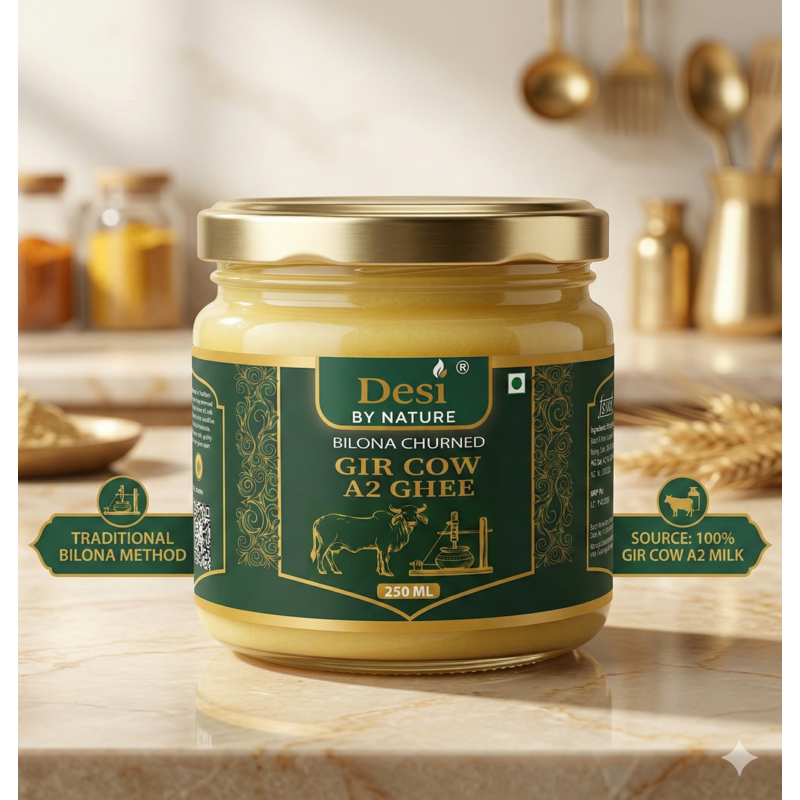
When curd is churned for bilona ghee, butter rises and gathers on the surface. What is left underneath is chaas: thin, tangy, slightly sour buttermilk. For each litre of ghee, the dairy is left with many times that volume of chaas. In village India, it is never wasted. It is drunk with lunch, used in kadhi, fed to animals, and given away to neighbours.
What real buttermilk is
The word "buttermilk" is used for two different things.
Traditional buttermilk, chaas, is the liquid left after churning butter out of cultured curd or cream. It is naturally low in fat, since most of the fat has become butter, and it contains the milk proteins, lactose that has not been fermented, minerals and the live cultures from the curd.
Commercial "cultured buttermilk" in many countries is simply low-fat milk fermented with bacteria, not a by-product of butter making.
Indian packaged chaas is usually diluted, spiced curd. It tastes similar to traditional chaas and is made for convenience.
Chaas and ghee: two halves of the same process
This is worth understanding if you buy bilona ghee. When whole curd is churned, the fat goes into butter and ultimately into the ghee jar. The protein, milk sugar and water mostly stay in the chaas. That is why ghee has almost no protein, and why an A2 claim on ghee is about the milk source rather than the jar contents. The A2 protein went into the chaas.
It is also part of why bilona ghee costs more: most of the value of the milk leaves the process as chaas, which sells for very little.
Chaas across India
- Gujarat: chaas with nearly every lunch, often with roasted cumin and a pinch of salt.
- Rajasthan: chaas and raabdi, a fermented millet and buttermilk drink.
- Punjab: lassi's thinner, salted cousin, sometimes with mint.
- Tamil Nadu and Karnataka: neer mor or majjige, spiced with ginger, green chilli, curry leaves and coriander, and often given free in summer at temples and street corners.
- Kerala: sambharam, with shallots, ginger and curry leaves.
- Maharashtra: taak, used in taakachi kadhi.
How to make good chaas at home
- Whisk ½ cup plain curd until smooth.
- Add 1½ cups cold water and whisk again, or blend briefly.
- Add ½ tsp roasted cumin powder, a pinch of black salt, and regular salt to taste.
- Crush in a little ginger and green chilli, and some coriander or mint leaves.
- For a South Indian touch, heat ½ tsp ghee, splutter mustard seeds, add curry leaves and a pinch of hing, and pour over the chaas.
If you make butter at home from malai or curd, the liquid left after churning is the real thing. Season it the same way.
Cooking with chaas
- Kadhi: sour chaas makes excellent kadhi. See kadhi pakora with ghee.
- Mor kuzhambu: a South Indian buttermilk curry with vegetables and coconut.
- Marinades: chaas tenderises chicken and paneer.
- Dough: some families knead roti or thepla dough with chaas for softness.
- Dhokla and handvo batters: sour buttermilk adds tang.
Why it is loved in summer
Chaas is cooling, light and refreshing in heat, and a traditional way to end a heavy meal. Claims that it fixes digestive problems are overstated, but a cold glass of spiced chaas after lunch in May is a pleasure few people argue with.
Chaas and ghee are made in the same churning. The buttermilk stays in the village. The butter becomes our Desi Cow A2 Ghee and A2 Gir Cow Ghee.