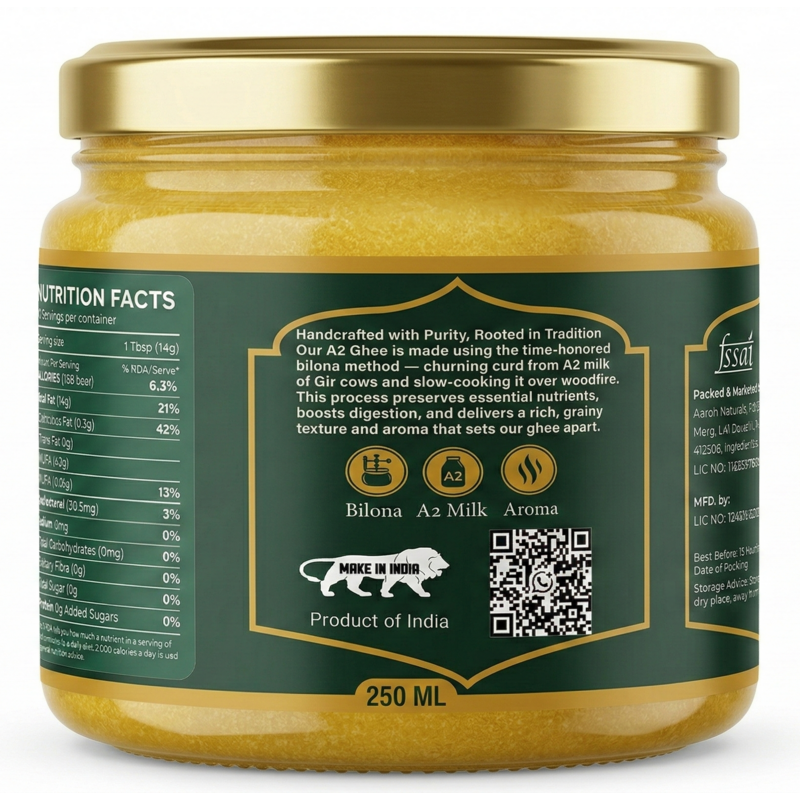
We say it plainly on our homepage, and it surprises people: we do not make ghee. We are not a dairy and we do not own cows. What we do is find people who make ghee properly, check that they do it consistently, and put our name on the jar only when we are confident about what is inside.
That makes the choice of dairy the most important decision in our business. Here is what we look at when we evaluate one. It is not a secret formula. It is closer to a long list of things that are easy to get wrong.
The animals
We start with the cattle, because everything else depends on the milk. We want to see the breed for ourselves rather than read it on a certificate. For our Gir ghee, that means Gir cows, and it is not hard to recognise them: the domed forehead and long, folded ears are distinctive.
We look at how the animals are kept. Are they healthy and calm? Is there shade and clean water? Do they graze, or are they tethered all day? We are not veterinarians, but there is a lot you can tell from spending a morning in a cattle shed, and a dairy that neglects its animals rarely takes care over anything else.
The milk handling
Raw milk spoils quickly in Indian heat. We want to know how long it sits between milking and boiling, what vessels it is held in, and whether milk from outside sources is ever mixed in during a lean month. That last question matters more than any other. A dairy that runs short of its own milk and quietly buys from the market is no longer the dairy you think you are buying from.
The curd
The curd step is what makes bilona ghee bilona. We ask to see it: how the milk is cooled, how it is cultured, how long it sets, and how that changes between summer and winter. A dairy that describes the process vaguely, or that seems to skip straight from milk to cream, gets more questions.
The churning and the butter
We watch the churning and look at the makkhan. Butter that is not washed well carries buttermilk into the cooking vessel, and that shows up later as a sour or scorched note in the ghee. It is a small step that tells you a lot about the maker's patience.
The cooking
This is where skill shows most. Too little heat leaves moisture in the ghee, which shortens its life. Too much burns the milk solids. We look at the vessels, the flame, and how the person at the stove decides when the ghee is done. The good ones rarely use a thermometer. They watch the colour, listen to the crackle fade, and smell.
The kitchen
Clean does not mean clinical. Plenty of excellent traditional kitchens look nothing like a factory. But we look for the basics: clean vessels, covered storage, no strong odours nearby that fat could absorb, and straining cloths that are washed rather than reused as they are.
The paperwork
We check for a valid FSSAI licence. It is a legal minimum, not a mark of quality, but a dairy that does not bother with it tells you something about how it approaches rules generally.
The tasting
We taste ghee from several batches, not one. Any good maker can produce one exceptional batch for a visitor. What we want is consistency across weeks and seasons, allowing for the natural changes in colour and texture that come with the weather.
The lab
Finally, we send samples to an independent NABL-accredited laboratory. For our Gir ghee, that continues with every batch we sell. The tests check for the things a nose cannot: moisture, free fatty acids and markers of adulteration with vegetable fats. If you want to know what those numbers mean, our guide to FSSAI standards for ghee walks through them.
A dairy that is reluctant to have its ghee tested is one we walk away from, however good it tastes.
What makes us say no
- Any sign of milk being bought in from elsewhere without being disclosed.
- Vague answers about the curd step.
- Inconsistent batches that suggest shortcuts when demand is high.
- Reluctance to allow lab testing.
- A price that seems too good, because the arithmetic of what bilona ghee costs to make is hard to beat honestly.
Why we work this way
Because the alternative is buying ghee in bulk from whoever is cheapest and printing a good label. That is a common way to run a ghee brand, and it is not the one we wanted to build.
You can read more about our approach on the sourcing page, or see where it ends up in a jar of A2 Gir Cow Ghee.