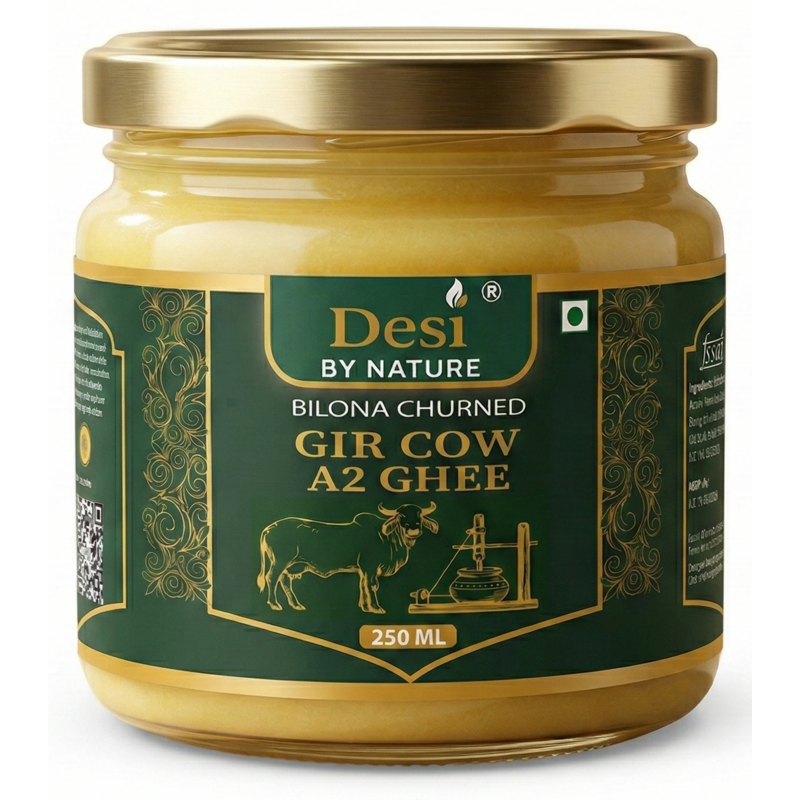
If you have browsed our shop, you will have noticed it does not take long. Two ghees. A turmeric, a hing and a Ceylon cinnamon. That is more or less it. We are regularly asked, sometimes kindly and sometimes with some bafflement, why we do not add more: cold-pressed oils, honey, jaggery, millets, dry fruit, the whole modern pantry.
It is a fair question. Here is the honest answer.
We do not make things. We find them.
We say it on our homepage and we will keep saying it: we are not a dairy, and we are not a spice farm. What we do is source. We look for people who make a particular product well, check that they do it consistently, and verify the result before we sell it under our name.
That approach has a natural speed limit. Finding one good bilona dairy, visiting it, tasting batches over time and setting up regular independent lab testing is slow. We described the process in what we look for before we sell a dairy's ghee. Doing that properly for fifty products would take a much larger team, or cutting corners. We would rather do it properly for a few.
Every product has its own ways to go wrong
Each food has its own quality problems, and each needs its own expertise to check.
- Ghee can be adulterated with vegetable fats and needs lab testing for moisture, free fatty acids and markers of other fats.
- Turmeric can be bulked with starch or coloured, and its value depends on curcumin content and freshness of grinding.
- Hing is always a compound of asafoetida resin with a carrier, and the quality depends entirely on the proportion and the resin.
- Cinnamon is very often cassia sold as cinnamon, which is a different spice altogether.
Honey, oils, millets and dry fruits each have their own list. Adding a product is not just adding a listing. It is taking on a new set of things to verify.
Why ghee is at the centre
Ghee is the product we care about most and the one most exposed to adulteration and loose claims. It deserved most of our attention, so it gets most of it. Our A2 Gir Cow Ghee comes from Gir cow dairies we have vetted, and every batch is tested by a NABL-accredited lab. Our Desi Cow A2 Ghee came later, for customers who wanted lab-tested bilona ghee from indigenous cow milk at a lower price for everyday cooking.
Why these spices
The spices are the ones that are used with ghee in almost every Indian kitchen, and that are among the most commonly faked or diluted.
Turmeric, from Erode in Tamil Nadu, is a high-curcumin variety, ground in small lots. You can see it on the turmeric page.
Hing is a compound made from Iranian resin, hand-graded and blended in small batches. It is on the hing page.
Ceylon cinnamon is the true Sri Lankan spice, Cinnamomum verum, rather than the cassia commonly sold as cinnamon.
A tadka of ghee, hing and a pinch of turmeric is where most Indian cooking begins. It seemed like the right place for us to begin too.
What a small range lets us do
- Know every batch. We can tell you which batch you have and share its lab report.
- Answer questions properly. When you message us, the person replying knows the products in detail.
- Say no. When a batch or a supplier does not meet our standard, we can refuse it without a gap in a catalogue of hundreds of items forcing our hand.
- Keep prices honest. We are not cross-subsidising a large range, so each product is priced on what it costs.
Will we add more?
Probably, slowly, when we find something made well enough to put our name on and can verify it properly. If we add something, it will be because we are confident about it, not because a gap in the shop looks empty.
If there is a product you wish we sold, tell us. We keep a list, and it does influence what we look for.
In the meantime, the pantry is short on purpose. You can see all of it in the shop.