Few food questions in Indian households produce as much argument as ghee and cholesterol. One relative insists ghee is poison for the heart. Another forwards a video saying ghee lowers cholesterol. Doctors, dietitians and scientists have also changed their emphasis over the decades, which does not help. Here is a careful summary of where the evidence stands, written by people who sell ghee and would rather tell you the truth than a flattering story.
This is general information, not medical advice. If you have high cholesterol, heart disease, diabetes or a family history of heart disease, your doctor should guide your diet.
First, what cholesterol numbers mean
Blood cholesterol is carried in particles, most commonly discussed as LDL, often called "bad" cholesterol, and HDL, often called "good" cholesterol. High LDL is one of the best-established risk factors for heart disease. A lipid profile blood test measures these, along with triglycerides.
What is in ghee
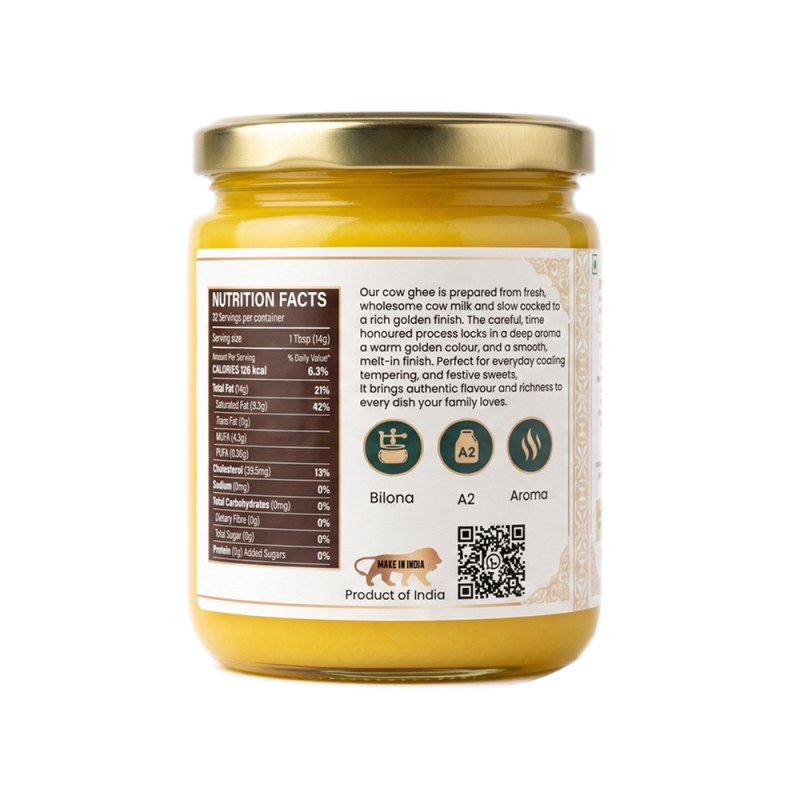
A tablespoon of ghee (14 g) contains roughly 9 g of saturated fat, 4 g of monounsaturated fat, a small amount of polyunsaturated fat, and around 40 mg of dietary cholesterol. You can see a label breakdown in calories in a spoon of ghee.
Saturated fat and LDL
This is the most important point, and the evidence here is strong and consistent. Diets high in saturated fat tend to raise LDL cholesterol in most people. Replacing some saturated fat with unsaturated fats is associated with lower LDL and lower risk of heart disease. That is why major health bodies, including the World Health Organization, recommend keeping saturated fat to less than about 10 percent of daily energy.
Ghee is mostly saturated fat, so large amounts of ghee can be expected to raise LDL in many people, as other saturated fats do.
Dietary cholesterol
For most people, cholesterol eaten in food has a smaller effect on blood cholesterol than saturated fat does, because the body adjusts its own production. Some people are more sensitive than others. The 40 mg or so in a tablespoon of ghee is modest compared with, for example, an egg yolk.
What studies specifically on ghee have found
Research specifically on ghee is limited and mixed. Some studies in Indian populations, including observational studies and small trials, have not found clear harm from moderate ghee intake, and a few animal studies have reported favourable effects. Other research has raised concerns, and some work has looked at oxidised cholesterol compounds that can form when ghee is heated for long periods at high temperatures, which may be undesirable.
The honest summary is that there is no strong evidence that moderate amounts of ghee are uniquely harmful, and no strong evidence that ghee protects the heart or lowers cholesterol. Claims in either direction usually rest on small or preliminary studies.
Why context matters
Ghee is rarely eaten on its own. How it affects someone depends on the whole diet: how much total and saturated fat they eat, how much fibre, vegetables, whole grains and pulses, how much fried and processed food, and how active they are. A spoon of ghee on dal and rice in an otherwise balanced, active life is a very different thing from ghee on top of a diet heavy in fried snacks and sweets.
Practical, evidence-based suggestions
- Moderate amounts. For many adults without a specific condition, a small amount of ghee a day as part of a balanced diet is compatible with general guidance.
- Mix your fats. Use ghee where its flavour matters and unsaturated oils such as mustard or groundnut for other cooking.
- Watch hidden fat. Festive sweets, fried snacks and restaurant food often contain more fat than home cooking.
- Avoid long, very high heat and repeated reuse of ghee for frying. See deep frying in ghee without waste.
- Know your numbers. A lipid profile tells you where you stand. Many Indian adults have unfavourable lipid levels without knowing it.
- If your LDL is high or you have heart disease, follow your doctor's advice on ghee and other saturated fats, even if it means less ghee than you would like.
What about A2 or Gir ghee specifically?
There is no good evidence that A2, Gir or bilona ghee affects cholesterol differently from other ghee. The fat composition is similar. Any marketing that says otherwise is ahead of the science.
We sell A2 Gir Cow Ghee and Desi Cow A2 Ghee as good food, made traditionally and verified carefully. We would rather you enjoyed them in sensible amounts for years than overdid them for a month.