Comparing ghee prices looks simple and is not. One brand sells by the kilo, another by the litre, a third in 200 ml jars. One includes shipping, another adds it at checkout. One shows a large discount on an MRP that may never be charged. Here is how to make a fair comparison.
1. Convert weight and volume
Ghee is lighter than water. A litre of ghee weighs roughly 910 grams, depending slightly on temperature.
- 1 litre ≈ 910 g
- 1 kg ≈ 1.1 litres
- 500 g ≈ 550 ml
- 500 ml ≈ 455 g
So a 1 kg pack contains about 10 percent more ghee than a 1 litre jar. If two brands charge the same for "1 kg" and "1 litre", the kilo pack is the better deal.
2. Work out price per ml or per 100 g
Divide the price by the quantity.
- ₹1,299 for 1 litre = ₹1.30 per ml, or ₹130 per 100 ml
- ₹699 for 500 ml = ₹1.40 per ml
- ₹7,499 for 5 litres = ₹1.50 per ml
Note that the biggest pack is not always the cheapest per ml. Here the 1 litre jar works out lower than the 5 litre dolchi, which is exactly why the division is worth doing.
For a kilo pack, divide by 1,100 ml to get a per-ml price you can compare with jars sold by volume.
3. Add everything you actually pay
- Shipping. A lower product price with ₹80 shipping on a small jar can cost more than a higher price with free shipping.
- Minimum order values for free delivery.
- Payment method charges, occasionally.
- Discount codes you will realistically use, such as a first-order discount, which only applies once.
4. Look past the MRP
The MRP is the maximum price that can be charged, not a measure of value. A large "70 percent off" on an inflated MRP means little. Compare what you pay, not the size of the discount.
5. Compare like with like
Price per ml only makes sense between similar products. Before comparing, check:
- Cow, buffalo or mixed milk. Buffalo ghee is usually cheaper. See cow vs buffalo ghee.
- Bilona or cream-separated. Bilona needs far more milk. See how much milk goes into bilona ghee.
- Indigenous breed, single breed or mixed herds.
- Packaging: glass or steel costs more than plastic.
- Testing: batch-linked lab testing costs money.
A cheap cream-separated buffalo ghee and an expensive Gir cow bilona ghee are not competing products, even though both are called ghee.
6. Use price as a reality check
Once you know roughly what goes into a product, price becomes a useful signal. A jar claiming to be indigenous cow bilona ghee at a price close to ordinary supermarket ghee does not add up. We explained why in why bilona ghee costs more and listed other warning signs in red flags for adulterated ghee.
A high price, on the other hand, proves nothing on its own.
7. Consider the cost per use
A flavourful ghee can go further. If one ghee lets you use a teaspoon on rice where a bland one needs two, its real cost per meal is lower than the sticker suggests. This is hard to measure, but worth keeping in mind when tasting.
8. Choose the right size
Bigger packs are often cheaper per ml, though not always, and only worth it if you finish them while the ghee is fresh. See which ghee size suits your family.
Our prices, laid out the same way
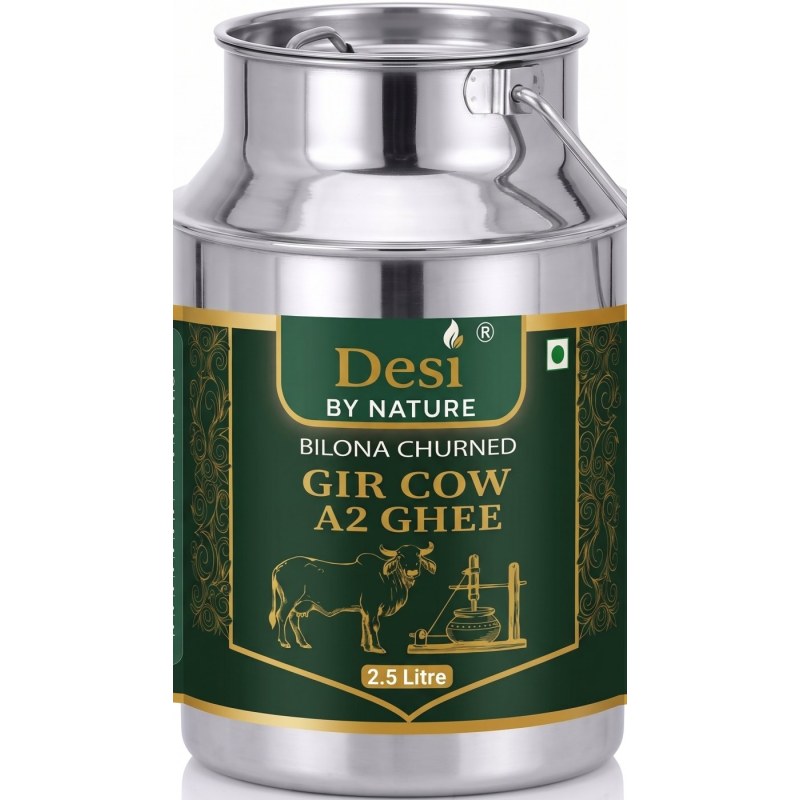
A2 Gir Cow Ghee: 250 ml ₹549 (₹2.20/ml), 500 ml ₹950 (₹1.90/ml), 1 litre ₹1,698 (₹1.70/ml), 2.5 litre dolchi ₹5,499 (₹2.20/ml), 5 litre dolchi ₹8,997 (₹1.80/ml).
Desi Cow A2 Ghee: 500 ml ₹699 (₹1.40/ml), 1 litre ₹1,299 (₹1.30/ml), 2.5 litre dolchi ₹3,999 (₹1.60/ml), 5 litre dolchi ₹7,499 (₹1.50/ml).
These are selling prices at the time of writing, with free shipping on ghee at every size. Current prices are always on the A2 Gir Cow Ghee and Desi Cow A2 Ghee pages.