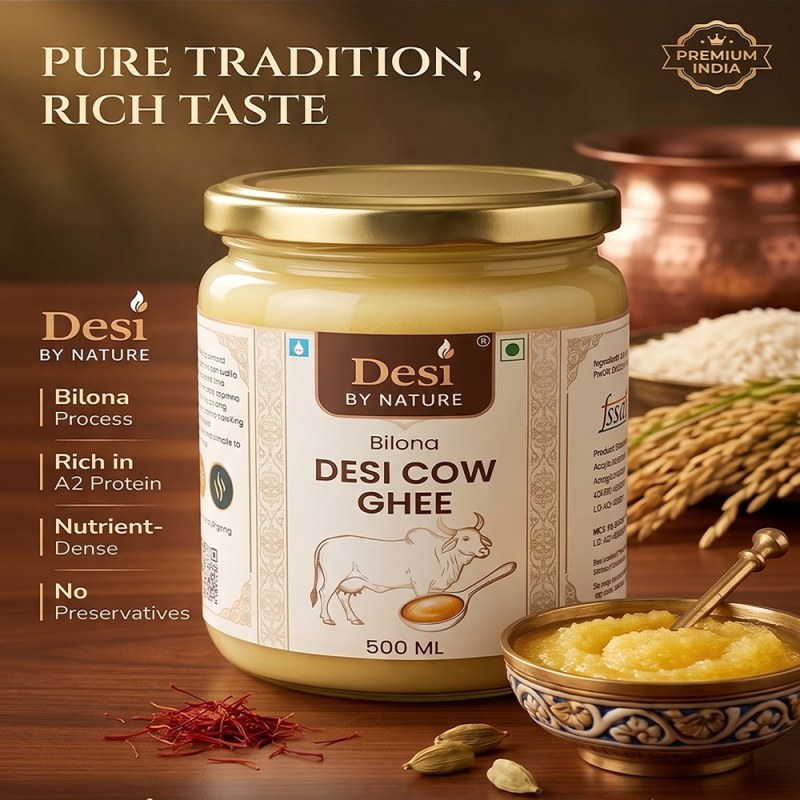
India does not have one relationship with ghee. It has dozens. Where a region grows wheat or rice, keeps cows or buffaloes, cooks with mustard, coconut or groundnut oil, and follows particular temple and household customs, all shape how ghee turns up on the plate. Here is a short tour. It is necessarily incomplete, and every family will know its own exceptions.
Rajasthan
A desert state with a pastoral tradition and a strong culture of cattle and camel herding, Rajasthan is perhaps India's most generous ghee region. Dal baati churma is almost a celebration of ghee, with baatis dunked in it. Ghevar, the honeycomb sweet of Teej, is fried in ghee. Bajra rotis in winter are eaten with ghee and jaggery. See dal baati churma.
Gujarat
Ghee is spread on rotli at almost every meal, and khichdi with ghee and kadhi is classic comfort food. Sweets such as sheero and mohanthal use plenty of ghee, and theplas are cooked in it for travel. See methi thepla.
Punjab and Haryana
Here white butter is as famous as ghee, dolloped on parathas and sarson ka saag. Ghee is used for tadkas, halwa, pinni and panjiri. Dhaba dal gets a double ghee tadka.
Uttar Pradesh and Bihar
Ghee goes into khichdi, especially on Makar Sankranti, when khichdi with ghee is traditional in many homes. Kachori and puri are fried in it for festivals. In Bihar, litti chokha is often dipped in ghee, and thekua for Chhath is fried in it.
Awadh and Hyderabad
The courtly cuisines of Lucknow and Hyderabad are known for dishes cooked in ghee: biryanis, kormas, sheermal and rich sweets. Here ghee is part of refinement and slow cooking.
Bengal and Odisha
Bengal cooks much of its food in mustard oil, but ghee has particular places: a little over hot rice with mashed potato, festive luchi, payesh, and certain dals and vegetable dishes. In Odisha, the prasad of the Jagannath temple in Puri is famously cooked in earthen pots, with ghee part of many of its preparations.
Maharashtra
The simplest Maharashtrian comfort meal is varan bhaat tup: plain dal, rice and ghee (tup). Puran poli is eaten with a generous pour of ghee or with milk. Modaks for Ganesh Chaturthi are served with ghee. Ghee is also central to sweets such as sheera and besan ladoo.
Andhra Pradesh and Telangana
A much-loved custom is the first bite of rice mixed with a spicy podi or pappu (dal) and a spoon of ghee. Ghee also finishes pulihora and sweet pongali.
Karnataka
Mysore pak, the royal sweet, is mostly ghee. Obbattu, the Karnataka puran poli, is eaten with ghee. Bisi bele bath is often finished with a ghee tempering and cashews. See Mysore pak.
Tamil Nadu
Temple kitchens are renowned for ghee-rich prasadam: sakkarai pongal, ven pongal and sweets from famous temples. At home, a spoon of ghee over hot rice with paruppu (dal) is a classic first course, and ghee roast dosa is a restaurant favourite. See ven pongal.
Kerala
Coconut oil dominates everyday Kerala cooking, but ghee is essential for ghee rice (neychoru), payasams during Onam and Vishu, and many temple offerings, including unniyappam in some traditions. See ghee rice.
The North-East and the Himalayas
In parts of the Himalayan region, ghee and butter play a role in local cuisines and in butter tea traditions, while many North-Eastern cuisines rely less on dairy fats. In Kashmiri Pandit cooking, ghee and mustard oil are both important, and dishes such as rajma and dum aloo are often tempered in ghee.
What they share
For all the variety, some things are common almost everywhere in India: ghee for festivals, ghee for temples and prayer, ghee for children and elders, and a spoon of ghee on hot rice or roti as a sign of care.
Wherever your family's traditions come from, our A2 Gir Cow Ghee and Desi Cow A2 Ghee ship free across India.