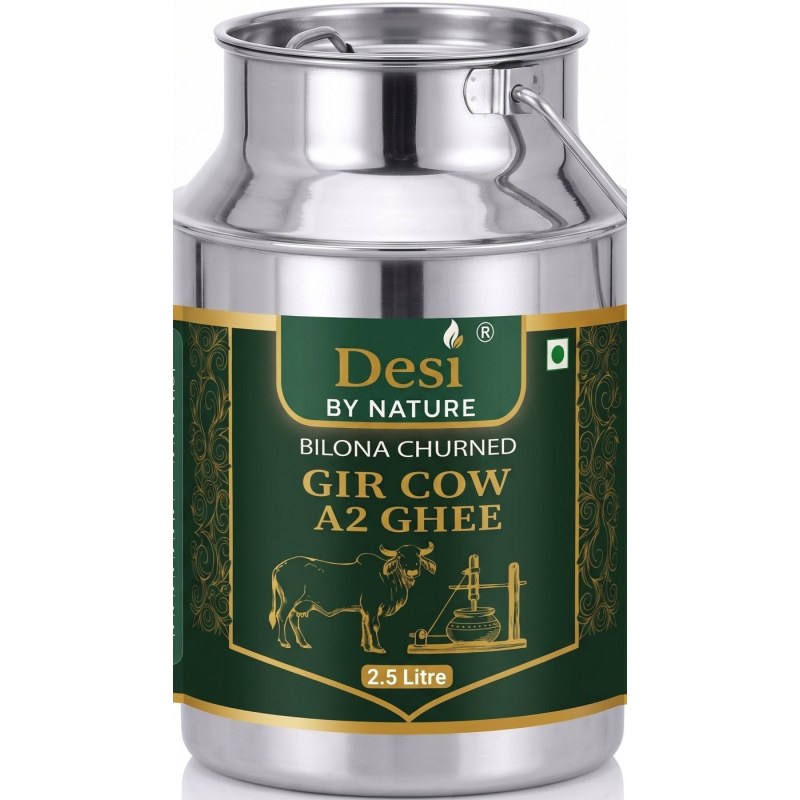
"Gir cow ghee" has become one of the most searched phrases in Indian food over the last few years. Some of that is fashion. Some of it reflects a real appreciation for one of India's great indigenous breeds. Here is what Gir cow ghee is, and just as usefully, what the phrase does not tell you.
The Gir breed
The Gir is an indigenous zebu breed that takes its name from the Gir hills and forests of the Saurashtra region in Gujarat. It is easy to recognise: a prominent, domed forehead, long pendulous ears that curl at the tips, horns that curve backward and outward, and a coat that ranges from red to speckled red and white.
Gir cattle are well adapted to heat and tropical conditions and have long been valued for their milk. The breed is admired enough that it has been exported and used in dairy breeding programmes in other tropical countries, notably Brazil, where Gir genetics contributed to widely used dairy breeds.
Like other indigenous Indian breeds, Gir cows predominantly produce milk with the A2 type of beta-casein.
What Gir cow ghee is
Quite simply, ghee made from the milk of Gir cows. When it is made by the bilona method, the milk is set into curd, churned into makkhan and slowly cooked, as described in how bilona ghee is made.
Why it is so sought after
Flavour and colour. Many people find Gir cow ghee rich and aromatic, often deep yellow in colour. Milk from Gir cows is generally in the richer part of the range for indigenous breeds, though it varies between animals, feed and seasons.
Tradition. Indigenous cow ghee holds a special place in Indian ritual and cooking, and Gir is among the best known of those breeds.
Support for native breeds. For many buyers, choosing Gir ghee is a way to support farmers who keep indigenous cattle rather than higher-yielding crossbreeds.
Scarcity. Genuine Gir milk is in limited supply compared with demand, and that makes the ghee both expensive and prized.
Why it costs more
Gir cows produce less milk than high-yield crossbred cows. Gir milk sells at a premium. Bilona ghee needs a lot of milk. Put those together and Gir cow bilona ghee is one of the most expensive ghees you can buy. We showed the arithmetic in why bilona ghee costs more.
What the label cannot promise
This is the part we think buyers deserve to hear.
- No lab test can confirm breed from ghee. Tests can check that ghee is genuine milk fat within legal standards. They cannot tell you whether the milk came from Gir cows. Breed claims depend on the honesty of the supply chain.
- Demand is larger than supply. It is reasonable to wonder how much ghee sold as "Gir" is entirely from Gir milk. Knowing the source dairy is the only real answer.
- It is not a medicine. Gir cow ghee is ghee. It has the same calories per spoon as any other ghee, and claims that it treats disease are not supported by evidence.
- A2 protein is not really in the ghee. Ghee contains almost no protein. The A2 label describes the milk source. See what A2 means.
How to buy it with more confidence
- Ask where the milk comes from, specifically. "Gujarat" is not an answer; a brand should be able to tell you how it chooses and checks its source dairies.
- Ask whether the milk is only from Gir cows, or pooled with milk from other breeds.
- Ask for a recent lab report matched to your batch.
- Be wary of prices that are close to ordinary ghee.
- Taste it warm. Good Gir bilona ghee should be strongly aromatic.
Is Gir ghee better than other indigenous cow ghee?
For flavour, many people think so, and we like it very much. Nutritionally, there is no good evidence that Gir milk fat is meaningfully different from the milk fat of other indigenous breeds. We sell both a Gir ghee and a ghee from desi indigenous cows, and compared them honestly in A2 Gir Cow Ghee vs Desi Cow A2 Ghee.
Our A2 Gir Cow Ghee comes from Gir cow dairies that we have vetted, is made by the bilona method, and is tested by a NABL-accredited lab every batch.