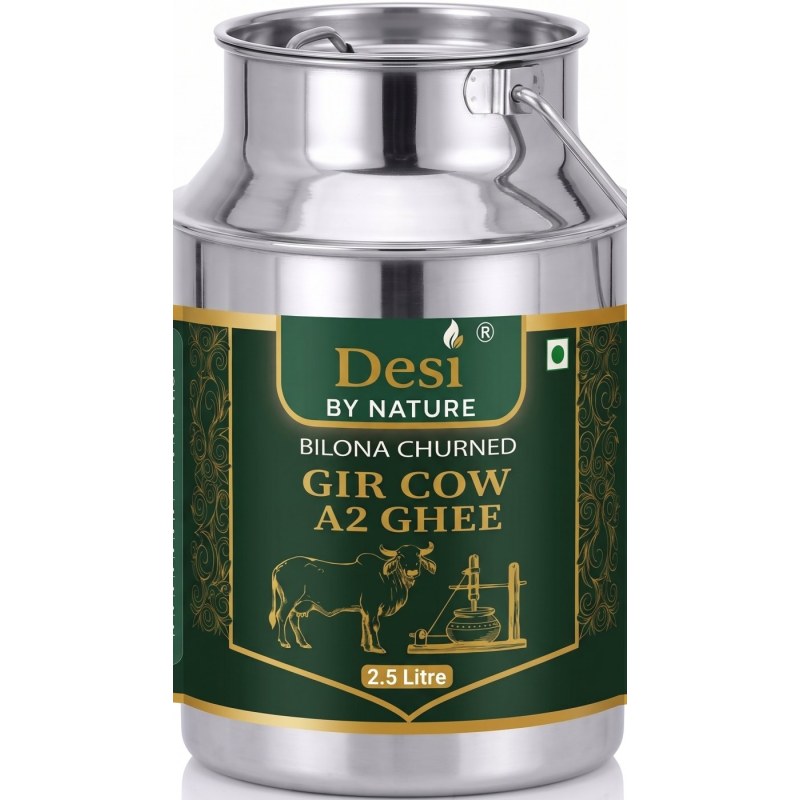
When people talk about A2 or desi ghee, a few breed names come up again and again, usually Gir and Sahiwal. But India is home to a remarkable diversity of indigenous cattle, shaped over centuries by local climate, terrain and farming needs. More than fifty cattle breeds are officially registered in India, and many more local types exist. Here is a brief guide to some of the best known.
Why indigenous breeds are different
Indian cattle are zebu, Bos indicus, with a characteristic hump, loose skin and a dewlap. They tend to tolerate heat, humidity and tropical diseases better than European cattle, and many thrive on local fodder. Most produce less milk per day than high-yield exotic breeds such as Holstein Friesian, and that is one reason many Indian dairy farmers switched to crossbreds over the past decades.
Indigenous breeds predominantly produce A2 beta-casein. See what A2 means.
Breeds are traditionally grouped as dairy breeds, draught breeds (for ploughing and transport) and dual-purpose breeds.
Dairy breeds
Gir. From the Gir hills of Saurashtra, Gujarat. Distinctive domed forehead and long, curled ears. Admired for milk and hardiness, and exported to other tropical countries for breeding. See what is Gir cow ghee.
Sahiwal. Originating in the Sahiwal region of Punjab, now in Pakistan, and widely kept in Indian Punjab, Haryana and elsewhere. Reddish-brown, docile, and considered one of the highest-yielding indigenous dairy breeds.
Red Sindhi. Originally from Sindh. Deep red coat, compact, heat tolerant, and a good milker. Used in breeding programmes in several countries.
Rathi. From the arid Bikaner region of Rajasthan. Hardy and well suited to desert conditions, valued for milk by pastoral communities.
Dual-purpose breeds
Tharparkar. From the Thar desert region. White or grey, very hardy, and valued for both milk and draught work in harsh conditions.
Kankrej. From the Rann of Kutch area of Gujarat and Rajasthan. Large, silver-grey with lyre-shaped horns. Strong draught animals whose cows also give good milk.
Hariana. From Haryana and nearby regions. White or light grey, widely used across North India for both work and milk.
Deoni. From the Marathwada region of Maharashtra and parts of Karnataka. Spotted black and white, used for draught and dairy.
Draught breeds
Ongole. From coastal Andhra Pradesh. Large, powerful and famous internationally; Ongole genetics contributed to the Brahman breed.
Kangayam. From Tamil Nadu. Strong draught cattle, closely associated with Jallikattu traditions.
Hallikar and Amrit Mahal. From Karnataka. Renowned draught breeds historically used in the Mysore kingdom's armies and farms.
Small and rare breeds
Vechur. From Kerala, one of the smallest cattle breeds in the world. Once close to extinction, it has been conserved through dedicated efforts.
Punganur. A dwarf breed from Andhra Pradesh, also the subject of conservation work.
Why these breeds matter
Many indigenous breeds declined sharply as farmers moved to crossbred cows for higher milk volumes. Some are now the focus of government and community conservation programmes. Indigenous cattle carry valuable traits such as heat tolerance and disease resistance, which matter more as climates warm.
When consumers choose products from indigenous breeds and pay a price that reflects their lower milk yield, it gives farmers a reason to keep them. That is a practical argument for indigenous cow ghee that does not depend on any health claim.
What a breed name on ghee can tell you
A breed name is a claim about the source. It cannot be confirmed by testing the ghee, so it depends on the honesty of the supply chain. A named source dairy is the best assurance. We compared single-breed and mixed indigenous ghee in A2 Gir Cow Ghee vs Desi Cow A2 Ghee.
Our A2 Gir Cow Ghee is made from Gir cow milk. Our Desi Cow A2 Ghee is made from the milk of desi indigenous cows.